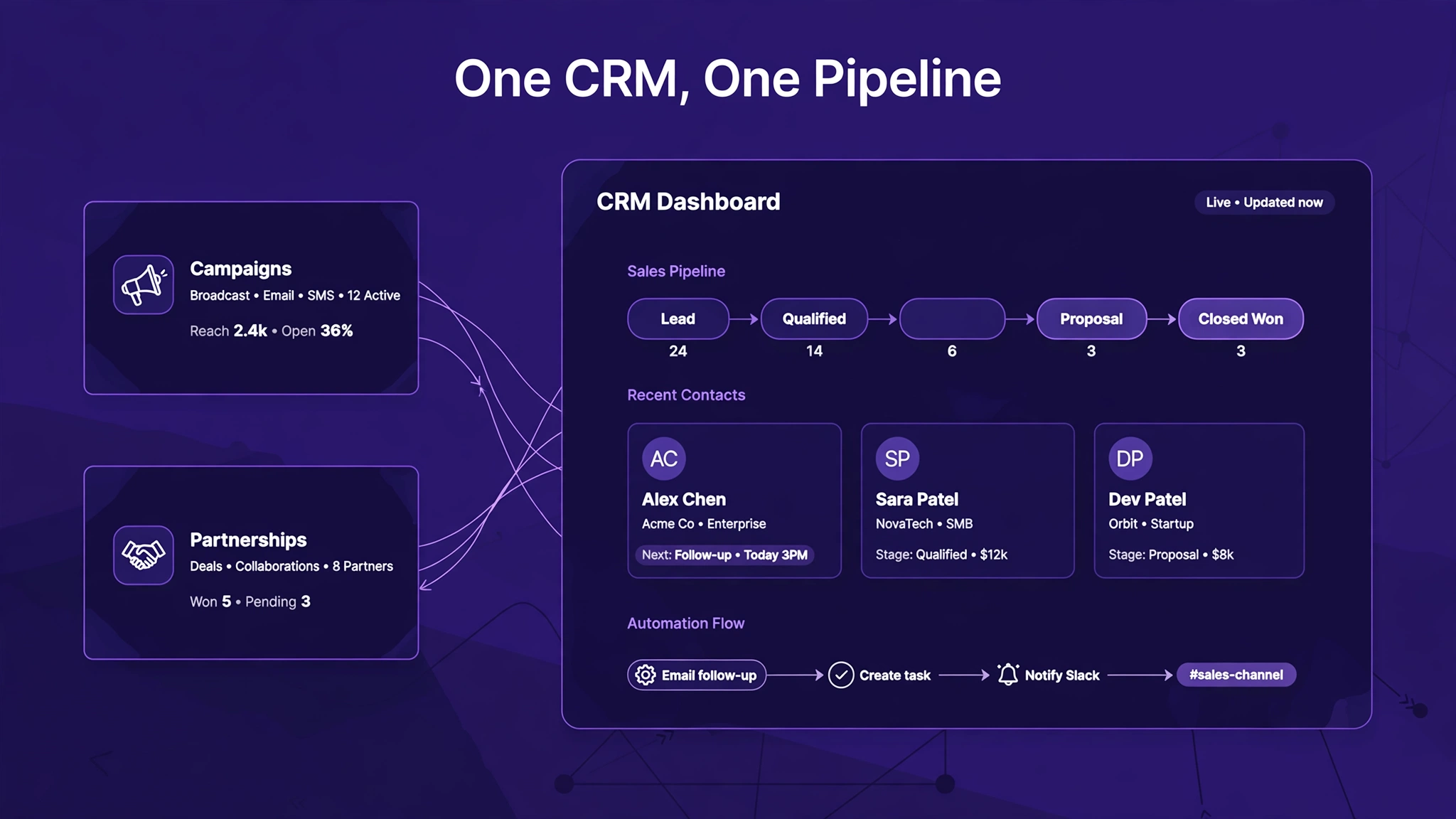
The Case for One CRM Running Both Marketing and Sales
Marketing has its tools. Sales has its own. The lead passes between them like a baton in a relay nobody practised, and somewhere in the handoff it gets dropped, duplicated or argued over.
One CRM running both marketing and sales gives both teams the same contact record, the same pipeline and the same numbers, so no lead is lost between handoffs and no deal is worked twice. Forrester's research puts the prize at 19% faster revenue growth and 15% higher profitability for aligned organisations.
This article makes the case for running both sides on one system, works through what the split actually costs, and shows how to consolidate without breaking the parts that already work.
Why do marketing and sales end up on different systems?
Marketing and sales end up on different systems because each team buys the tool that solves its own problem, and nobody owns the join between them. Marketing buys an email platform and a landing-page builder. Sales buys a CRM, or keeps working from spreadsheets. Both choices are sensible on their own. Together they build a wall down the middle of the revenue process.
The split rarely starts as a decision. It starts as a workaround. Marketing needs to send a campaign this week, so it picks the fastest email tool. Sales needs somewhere to track deals, so it picks the simplest CRM. A year later the business has five subscriptions, three versions of every contact, and no one who can say with confidence which campaign produced which deal.
The symptoms are easy to recognise. Marketing reports a record month of leads while sales complains the leads are rubbish. Sales closes a deal marketing never hears about, so the same customer keeps getting prospecting emails. A lead fills in a form twice and gets two different follow-up sequences. Nobody is lying. Each team is reporting accurately from its own system, and the two systems disagree.
What does the split actually cost a business?
The split costs revenue, time and trust — and the research behind each of those is unusually consistent. Forrester's research on the economics of alignment found that organisations with strong alignment across sales, marketing and product grow revenue 19% faster and are 15% more profitable than their peers. SiriusDecisions, the research firm behind that work, separately documented 24% faster three-year revenue growth and 27% faster profit growth for aligned B2B organisations.
The perception gap is part of the problem. Forrester's 2024 research found that 82% of C-level executives believe their sales and marketing teams are aligned, while 65% of frontline sales and marketing professionals report a lack of alignment between their leaders. The people at the top think the handoff works. The people doing the handoff know it does not.
The time cost shows up in the sales week itself. Salesforce's State of Sales report, seventh edition (2026), surveyed 4,050 sales professionals in 22 countries and found the average seller spends only 40% of the working week selling — customer meetings (22%) and prospecting (18%). The other 60% goes to quotes, planning, training and manually entering data. Every hour a rep spends retyping information that already exists in marketing's system is an hour not spent talking to a buyer.
The data cost is the quietest and the largest. Gartner's widely cited research puts the average annual cost of poor data quality at $12.9 million per organisation. Two systems holding two versions of the same contact is not a minor admin annoyance; it is a standing invitation to send the wrong message to the wrong person at the wrong time.
And the performance gap is measurable at the individual level too. HubSpot's 2024 Sales Trends Report found that sales professionals at companies with aligned systems and processes are 103% more likely to exceed their targets than those without.
| Where the split shows up | What it looks like day to day | What one CRM changes |
|---|---|---|
| Lead handoff | Marketing exports a list; sales works from a spreadsheet; nobody knows which leads were touched | Handoff becomes a pipeline stage change, not a file transfer |
| Follow-up speed | A hot lead waits hours while someone copies details between systems | The workflow fires the moment the lead acts |
| Reporting | Two dashboards, two versions of the truth, one argument | One pipeline number both teams sign |
| Data quality | Three versions of every contact, none of them current | One record, updated by every touch |
| Accountability | Marketing blames lead quality; sales blames lead volume | Both teams are measured on the same pipeline |
What is a unified CRM?
A unified CRM is a single system that holds every contact, conversation, campaign and deal for both marketing and sales, so both teams work from the same record and the same pipeline. It is not simply one login. It is one contact record that marketing's emails, sales' calls and the customer's replies all update, and one pipeline that shows a lead's whole journey from first click to signed deal.
The distinction matters because many businesses already think they have this. They have a CRM, and marketing has access to it. But if marketing still runs campaigns from a separate email tool, and the results only reach the CRM as a weekly export, that is two systems with a bridge, not one system. Bridges break. Exports go stale. Someone forgets to run the sync.
A genuinely unified CRM has three properties. First, one contact record: every touch, from either team, lands on the same profile. Second, one pipeline: marketing and sales see the same stages, in the same order, with the same definitions. Third, one set of numbers: the report marketing shows the owner is the report sales shows the owner, because both come from the same data.
What changes when marketing and sales share one pipeline?
The first thing that changes is the argument about lead quality, because both teams can finally see the same lead. Marketing sees which of its leads became deals and which went quiet, so it stops optimising for form fills and starts optimising for revenue. Sales sees what a lead read, clicked and replied to before the call, so the first conversation starts from context instead of a cold introduction.
The second change is speed. When a lead books a call, downloads a guide or replies to an email, the workflow in a unified CRM can notify the right person, move the deal to the next stage and start the follow-up sequence in seconds. There is no export, no copy-paste, no "I'll get to it after lunch". Our earlier guide to why GoHighLevel workflows break at scale covers the failure modes to avoid when those automations carry real revenue.
The third change is attribution. When marketing and sales share one system, the business can finally answer the question every owner asks: which campaign produced which deal? Our guide to HighLevel attribution reports walks through how that tracking works once the data lives in one place.
The fourth change is subtler and worth more than the other three: the two teams start trusting each other's numbers. A shared pipeline removes the most common source of friction between marketing and sales, which is not personality or effort but two different versions of the truth.
How does GoHighLevel run marketing and sales in one place?
GoHighLevel runs marketing and sales in one place because it was built as a single platform for both: contacts, pipelines, workflows, email and SMS, calendars, conversations, funnels and reporting live in the same account. There is no marketing module bolted onto a sales CRM, and no sales add-on for a marketing tool. The contact record a campaign writes to is the same record the sales call updates.
In practice that means a lead who clicks a Facebook ad, fills in a form and books a call has one continuous record: the ad source, the form answers, the booking, the call notes and the follow-up emails all sit together. Marketing can see the deal close. Sales can see the campaign that started it. Nobody exports anything.
It also means the automation layer serves both teams at once. The same workflow engine that sends a nurture sequence can score a lead, alert a rep when the score crosses a threshold, move the deal to the next stage when the call is booked, and send the onboarding sequence when the deal closes. One system, one set of rules, no handoff gap.
For businesses weighing the platform itself, our GoHighLevel pricing guide breaks down every plan with real costs, so the consolidation decision can be made on numbers rather than on a sales call.
How do you move both teams onto one CRM without breaking everything?
You move both teams onto one CRM in five steps: audit the current stack, agree shared definitions, migrate the data once, rebuild the three workflows that carry the most revenue, and run the old tools in parallel only until the new system proves itself. The order matters more than the speed.
- Audit the current stack. List every tool marketing and sales use, what data each one holds, and which of them anyone would actually miss. Most businesses find at least one subscription nobody has opened in months. Cancel it.
- Agree shared definitions. Marketing and sales must define a qualified lead together, in writing, with the same criteria. This is the single most valuable meeting in the whole move, and it costs nothing. If the two teams cannot agree on what a good lead is, no software will fix it.
- Migrate the data once, properly. Export every contact from every system, deduplicate, and import into the one CRM. This is the step most often rushed and most often regretted. A messy import poisons the new system on day one. If the cleanup is bigger than your team can handle in a week, hand it to a specialist: our pay-as-you-go service covers one-off CRM tasks, including data cleanup and migration, at $80 per 4-hour block.
- Rebuild the three workflows that carry the most revenue. Not all of them — the three. Lead capture to first response, lead to booked call, and booked call to closed deal. Get those three running cleanly before touching anything else.
- Run the old tools in parallel for two weeks, then switch them off. Parallel running is a safety net, not a permanent arrangement. Pick a cutover date in advance, and stick to it. A business that runs two CRMs "just in case" for six months has simply paid for the old problem twice.
When is one CRM the wrong call?
One CRM is the wrong call in a narrow set of cases: a very large enterprise with entrenched departmental systems and its own integration team, strict regulatory separation that genuinely requires marketing and sales data to live apart, or a specialist tool that does one job so well that replacing it would cost more than integrating it. Be honest about which of those applies to you. Most agencies and service businesses are none of the three.
The specialist-tool case deserves a word, because it is the one people use to justify keeping five systems. If your business genuinely needs a tool GoHighLevel does not replace — complex product analytics, say, or a niche industry system — the answer is to integrate that one tool with the CRM, not to keep a second CRM alongside it. One system of record, with specialist tools feeding into it, is still one CRM. Two systems of record is the problem this article is about.
Bottom line
Marketing and sales are not two businesses. They are two halves of one revenue process, and running them on separate systems guarantees that the halves will disagree about the numbers, lose leads in the handoff, and waste selling time on admin that a shared system would have handled automatically. The research is unusually clear on this: aligned organisations grow faster, keep more customers and hit quota more often.
One CRM does not fix a bad offer or a weak team. What it does is remove the gap between the team that finds the customer and the team that closes them — and for most businesses, that gap is where the revenue is leaking.
Ready to run marketing and sales from one system? See what CRM Automates does — a GoHighLevel certified company trusted by 300+ businesses, with 150+ team members and 24/7 live expert support — or book a call to scope the move. If you want a team to run the whole thing for you, the shared marketing team covers CRM, media buying, design, social, video, SEO and growth for $1,250 a month.
FAQ
What does it mean to unify marketing and sales in one CRM?
It means both teams work from the same contact record, the same pipeline and the same numbers in a single system. Marketing's campaigns, sales' calls and the customer's replies all update one profile, so a lead's whole journey from first click to signed deal is visible to everyone. It is one system of record, not two systems connected by exports.
Is GoHighLevel good for both marketing and sales?
Yes. GoHighLevel combines contacts, pipelines, workflows, email and SMS, calendars, conversations, funnels and reporting in one account, so it serves both sides without a separate marketing tool or a separate sales CRM. Marketing runs campaigns and nurture sequences in it; sales works the pipeline, books calls and closes deals in the same records.
How much does it cost to run marketing and sales on one CRM?
It depends on the stack you replace, but consolidation usually cuts subscription costs as well as admin time, because one platform replaces several. GoHighLevel's plans are broken down with real costs in our pricing guide. If you want a team to run it, CRM Automates' shared marketing team is $1,250 a month, and one-off setup or migration tasks are $80 per 4-hour block.
What happens to our existing tools when we consolidate?
Most of them go. The email tool, the separate landing-page builder and the spreadsheet tracker are replaced by the CRM's own features. A genuinely specialist tool that does one job well can stay and integrate with the CRM, but anything that merely duplicates what the CRM already does should be cancelled once the migration is proven.
How long does it take to move marketing and sales onto one CRM?
For a typical agency or service business, two to four weeks: a few days to audit and agree definitions, a week for the data migration and cleanup, and a week to rebuild the three core workflows and run the old tools in parallel. Larger or messier databases take longer, and the data cleanup is usually what sets the pace.
Do marketing and sales still need separate teams if they share one CRM?
Yes. Sharing a system is not the same as sharing a job. Marketing still creates demand and sales still closes it; what changes is that both teams work from the same record, the same pipeline and the same numbers. The CRM removes the handoff gap — it does not remove the need for people who are good at each half of the work.