GoHighLevel vs HubSpot: Which One Actually Fits in 2026
GoHighLevel vs HubSpot: The Honest Comparison Every Agency Owner and CEO Needs in 2026
You're evaluating GoHighLevel and HubSpot, and every comparison article you've found either reads like an affiliate review or gives you a feature table without telling you what any of it actually means for your specific situation.
Here's the straightforward version. GoHighLevel and HubSpot are not direct competitors in any meaningful sense. They're built for different buyers, different business models, and different operational realities. Choosing the wrong one doesn't just cost money — it costs months of your team's time and the opportunity cost of a sales and marketing system that never quite fits. This comparison covers who each platform actually serves, where each one falls apart, and how to make the call without second-guessing yourself in six months.
What Each Platform Actually Is
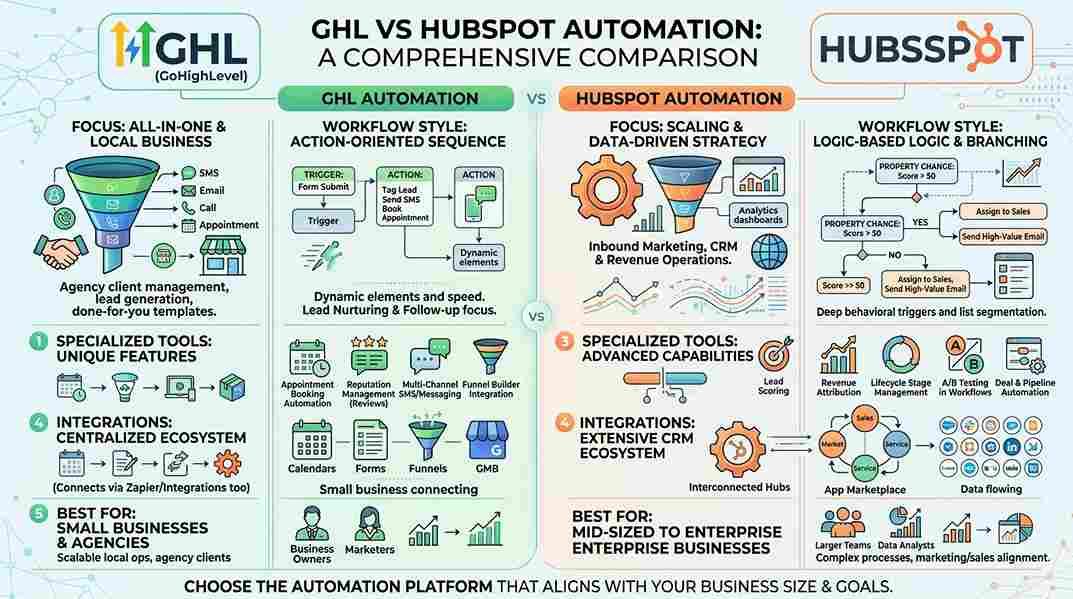
GoHighLevel is an all-in-one sales, marketing, and CRM platform built specifically for marketing agencies and service businesses. It combines CRM, email and SMS marketing, funnel building, appointment scheduling, reputation management, and white-label capability under a single flat monthly fee.
HubSpot is a modular CRM and marketing platform built for growth-stage businesses across sales, marketing, and customer service. It operates on a hub model where each functional area — Marketing Hub, Sales Hub, Service Hub, Content Hub — is purchased separately and scales in price as contact lists and feature requirements grow.
The architectural difference matters more than any individual feature comparison. GoHighLevel is a monolith built for agencies running multiple client accounts. HubSpot is a modular ecosystem built for companies managing their own internal go-to-market operations. Once you understand that, most of the comparison resolves itself.
Pricing Reality: What You Actually Pay
Pricing is where most comparisons mislead by quoting starting numbers without total cost context.
GoHighLevel's Agency Starter plan runs approximately $97 per month at the time of writing. The Agency Unlimited plan is approximately $297 per month. These flat fees include CRM, automation, funnels, email, SMS, calendars, and reputation management across unlimited sub-accounts on the Unlimited tier. Verify current pricing at gohighlevel.com as plan structures change.
HubSpot's pricing works completely differently. The free CRM tier is genuinely useful but functionally limited — you hit the ceiling quickly on automation rules, contact limits, and reporting depth. HubSpot Sales Hub Professional starts at approximately $90 per seat per month. Marketing Hub Professional starts at approximately $800 per month for up to 2,000 marketing contacts. Enterprise tiers exceed $3,000 per month for larger contact databases. Verify current pricing at hubspot.com before budgeting.
For a 10-person agency running 20 client accounts, GoHighLevel at $297 per month flat versus HubSpot requiring multiple hub subscriptions for each client is not a close financial comparison. For a single company managing its own internal marketing with 50,000 contacts and a dedicated marketing team, HubSpot's depth justifies the cost in a way GHL can't.
The total cost of ownership also includes implementation. GoHighLevel's setup complexity is real — teams without a GHL expert or certified implementation support routinely spend 60 to 120 hours getting workflows, sub-accounts, and automation configured correctly. HubSpot's onboarding is more structured but charges mandatory onboarding fees at the Professional tier, running from $1,500 to $3,500 depending on the hub.
Where GoHighLevel Wins Clearly
GoHighLevel wins on three specific scenarios, and it wins decisively on all three.
Marketing Agencies Managing Multiple Clients
GHL's sub-account architecture is the feature that changes everything for agencies. Each client gets a dedicated sub-account with its own CRM, pipelines, automation, and reporting — all managed from a single agency dashboard. White-label capability means the platform can be presented to clients under the agency's own brand name.
For an agency running 15 to 30 client accounts, the alternative to GHL is either individual HubSpot subscriptions per client or a patchwork of separate tools for each function. Neither is financially or operationally competitive with what GHL provides at $297 per month flat.
Local Service Businesses and Coaches
Chiropractors, real estate agents, insurance brokers, fitness coaches, and home service businesses in the US, UK, and Canada don't need the enterprise depth of HubSpot. They need appointment booking, lead capture, automated follow-up via SMS and email, Google review management, and a pipeline to track prospect status. GHL covers all of this out of the box. HubSpot covers most of it only at mid-tier or above, and charges per contact and per seat.
All-in-One Replacement for Multiple Tools
A business currently running separate subscriptions for ClickFunnels, ActiveCampaign, Calendly, a reputation management tool, and a basic CRM can replace all five with GoHighLevel. The consolidation math is straightforward. Five tools at $50 to $100 per month each versus GHL at $97 or $297 per month is a meaningful cost reduction with the added benefit of everything running inside the same system.
Where HubSpot Wins Clearly
HubSpot wins in scenarios where GoHighLevel genuinely cannot compete, and it's important to be honest about that.
Enterprise B2B Companies with Complex Marketing Operations
HubSpot's Marketing Hub at the Professional and Enterprise tiers provides A/B testing, advanced segmentation, attribution reporting, predictive lead scoring, and native integration depth that GHL's marketing automation simply doesn't match. For a B2B SaaS company running multi-touch attribution across paid, organic, and email channels with a 10-person marketing team, HubSpot is the right infrastructure. GHL isn't built for that complexity.
Companies Requiring Deep CRM Customization
HubSpot's CRM supports custom objects, multi-step workflows with complex conditional logic, sales forecasting, deal rotation rules, and territory management at the Enterprise tier. For sales organizations with 50-plus reps, multi-currency pipelines, and regulatory compliance requirements, HubSpot's depth is necessary. GHL's CRM works well for simpler pipeline structures but doesn't scale to that level.
Teams Needing a Large Integration Ecosystem
HubSpot's App Marketplace includes over 1,400 native integrations as of 2025. Salesforce, Slack, Zoom, Shopify, NetSuite, Google Ads, and hundreds of others connect natively. GoHighLevel's direct integration library is more limited, with most third-party connections requiring Zapier or Make as middleware. For businesses with an existing tech stack that needs to connect cleanly, HubSpot wins on ecosystem depth.
GoHighLevel Automation vs HubSpot Automation
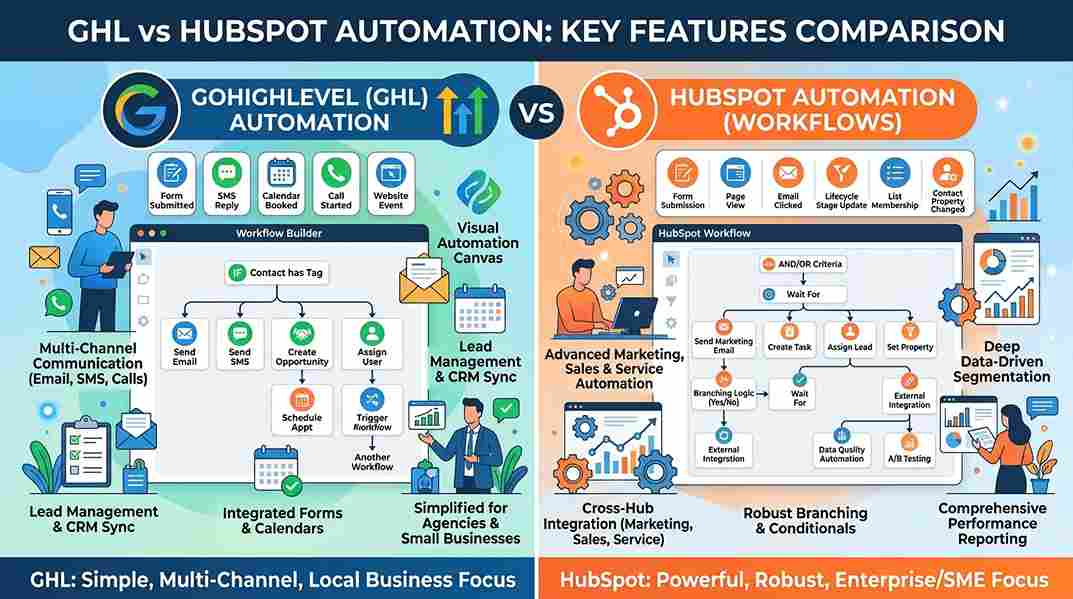
GoHighLevel automation is workflow-based, built around triggers like form submissions, appointment bookings, pipeline stage changes, and inbound SMS or calls. Sequences can span email, SMS, voicemail drops, and internal task assignments. The visual workflow builder is functional and covers most agency use cases without requiring developer involvement.
HubSpot's workflow automation at the Professional tier is more sophisticated in terms of conditional branching, contact list enrollment criteria, and cross-object automation. It handles more complex logic — for example, enrolling a contact in a sequence only if they've visited a specific page, come from a specific lead source, and meet a demographic threshold simultaneously. GHL's conditional logic is more limited by comparison.
For most agencies and service businesses, GHL's automation depth is sufficient and significantly easier to configure without technical expertise. For marketing operations teams running complex nurture sequences with multi-variable enrollment criteria, HubSpot's automation is the right tool.
The Role of GHL Experts in Getting Value From GoHighLevel
GoHighLevel's breadth is its biggest advantage and its biggest risk. The platform can replace eight tools — but only if it's configured correctly. Out-of-the-box, GHL is a collection of powerful features with no opinionated defaults to guide setup.
GHL experts are implementation specialists who configure GoHighLevel sub-accounts, automation workflows, funnel templates, and reporting dashboards for agencies and businesses that want results without spending months on trial and error. A well-configured GHL system takes 40 to 80 hours of competent setup work. An expert collapses that into days rather than months.
For agencies evaluating GHL, the honest implementation question isn't "can we figure this out?" It's "how many billable hours will we lose while we do?" The answer typically determines whether hiring an expert is cost-effective — and in most agency contexts, it is.
The Honest Trade-offs
Both platforms have real limitations worth naming directly.
GoHighLevel's limitations include a steeper learning curve than the marketing suggests, customer support that receives mixed reviews on platforms like G2 (where GHL holds a 4.4 out of 5 rating with frequent support response time complaints as of 2025), and a reporting layer that is functional but not deep enough for enterprise analytics needs.
HubSpot's limitations include a pricing model that becomes expensive quickly as contact lists and feature requirements grow, mandatory onboarding fees that add to first-year cost, and a platform architecture that encourages dependency on the HubSpot ecosystem — switching costs after two-plus years of HubSpot use are significant.
Neither platform is the right answer for everyone. The decision is a function of business model, team size, operational complexity, and budget — not a universal winner.
How to Make the Decision
If you're an agency owner managing multiple clients, or a service business that needs CRM, automation, funnels, and reputation management in one place at a predictable cost, GoHighLevel is the right choice for your situation.
If you're a growth-stage company with an internal marketing team, a complex integration stack, or enterprise-level CRM requirements, HubSpot is the right choice and the cost is justified by the depth.
If you're already on HubSpot and considering a switch, run the total cost comparison honestly — including implementation time, migration effort, and the functionality you'd lose. For most agencies, the switch to GHL makes financial sense. For most in-house marketing teams at mid-market or above, it doesn't.
Bookmark the pricing decision checklist in the comparison section of this article before making the call. Both platforms offer trials or demos — use them with your actual use cases, not the vendor's demo scenarios.
The Bottom Line on GoHighLevel vs HubSpot
The GoHighLevel vs HubSpot comparison resolves clearly when you match each platform to the business model it was designed for. GHL was built for agencies and service businesses that need operational breadth at a flat cost. HubSpot was built for companies that need deep marketing and sales infrastructure with room to scale.
If you're running an agency or a local service business in the US, UK, or Canada and haven't configured GHL properly yet, working with GHL experts who can set up your sub-accounts, automation, and workflows correctly is the most direct path to getting the value the platform promises.
The wrong platform choice is expensive. The right one, properly configured, pays for itself quickly — through reduced tool spend, better automation, and a sales process that actually runs without someone pushing it manually every day.
FAQ
What is the main difference between GoHighLevel and HubSpot? GoHighLevel is built for marketing agencies and service businesses needing an all-in-one platform with white-label and multi-client management capability. HubSpot is a modular platform built for growth-stage companies managing their own internal marketing and sales operations. The core difference is architecture — GHL is a monolith for agencies; HubSpot is a modular ecosystem for in-house teams.
Is GoHighLevel cheaper than HubSpot? For agencies and businesses managing multiple clients or replacing multiple tools, GoHighLevel is significantly cheaper. GHL's Agency Unlimited plan runs approximately $297 per month flat. HubSpot's equivalent functionality across Marketing Hub, Sales Hub, and CRM scales to thousands of dollars per month depending on contact volume and user seats. Verify current pricing at each platform's official website.
Can GoHighLevel replace HubSpot? For agencies and local service businesses, yes. GHL covers CRM, email and SMS automation, funnels, appointment booking, and reputation management in one platform. For enterprise B2B companies with complex integration requirements, multi-touch attribution needs, or large sales teams requiring advanced forecasting, HubSpot's depth is not replicated by GHL.
What are GHL experts and do I need one? GHL experts are specialists who configure GoHighLevel correctly — setting up sub-accounts, automation workflows, funnel templates, and reporting for agencies and businesses. Most teams without prior GHL experience benefit significantly from expert implementation. The platform's breadth means configuration without guidance often results in a partially functional system that underdelivers on its capability.
Which is better for a marketing agency, GoHighLevel or HubSpot? GoHighLevel is the better fit for most marketing agencies. The sub-account architecture, white-label capability, and flat pricing model are specifically designed for agency operations. HubSpot is better suited for agencies that work primarily with enterprise B2B clients requiring HubSpot-native reporting and attribution, which is a narrower use case.
Is GoHighLevel good for coaches and consultants? Yes. GHL covers the core needs of most coaches and consultants — appointment scheduling, lead capture funnels, automated follow-up sequences, payment integration, and pipeline tracking — at a price point that makes sense for individual practitioners and small teams. HubSpot's equivalent functionality at the same level requires a higher monthly investment.