Best CRM Systems with Built-In Marketing Automation in 2026 — Ranked & Reviewed for Every Business Size
You're losing leads. Not because your product isn't good enough, but because your tools aren't talking to each other.
Your CRM sits in one tab. Your email platform in another. Your landing page builder somewhere else entirely. And somewhere between a contact filling out a form and your sales rep picking up the phone, that lead goes cold.
This is the exact problem that a CRM with built-in marketing automation solves — and in 2026, it's no longer a "nice to have" for growth-focused businesses. It's the operational backbone that separates companies scaling predictably from those stuck in manual follow-up loops.
This guide cuts through the noise. Whether you're running a B2B SaaS startup, managing an agency, scaling an ecommerce brand, or simply trying to grow a small business without hiring a marketing team, you'll find an honest, detailed breakdown of the best CRM systems with marketing automation built right in, along with everything you need to make the right call for your specific situation.
What Is CRM Marketing Automation and Why Does It Matter in 2026?
Before you invest in any platform, it's worth being clear about what you're actually buying, because the term "CRM with marketing automation" gets thrown around loosely, and not every tool that claims it delivers the real thing.
At its core, CRM marketing automation is the combination of customer relationship management (storing, tracking, and managing your contacts and deals) with automated marketing workflows (sending the right message, to the right person, at the right time, without manual intervention). When both live inside one platform, the magic happens: your marketing data feeds your sales pipeline, and your sales activity informs your marketing campaigns.
In 2026, with buyer journeys growing more complex and attention spans shrinking, businesses that rely on disconnected tools are operating at a serious disadvantage. The brands winning right now have one unified system that tracks every touchpoint, from the first website visit to the closed deal.
How Does CRM Marketing Automation Actually Work?
Think of it as a series of intelligent, rules-based actions triggered by your contacts' behaviour.
A visitor lands on your pricing page. The system logs that behaviour and automatically adds them to a high-intent email drip campaign. Three days later, they open your third email but don't book a call. A behavioural trigger fires, alerting your sales rep and bumping the contact's lead score above your threshold. Your rep follows up the same afternoon, armed with full context, and closes the deal that week.
That entire sequence? Automated. No manual tagging, no spreadsheet updates, no dropped balls.
The technical engine behind this includes:
Visual workflow builder: drag-and-drop canvas where you map out multi-step automations based on conditions, delays, and actions
Contact segmentation: grouping contacts by industry, behaviour, lifecycle stage, or custom attributes so every message is relevant
Lead scoring: assigning point values to actions (page visits, email opens, form fills) to surface your hottest prospects automatically
Email drip campaigns: pre-built sequences that deliver the right content at each stage of the marketing funnel automation
Behavioural triggers: real-time actions fired when a contact does (or doesn't do) something specific
Omnichannel automation: running coordinated campaigns across email, SMS, social ads, and live chat from one dashboard
Predictive analytics: using historical data patterns to forecast which leads are most likely to convert, powered by AI-powered CRM capabilities
The result is a system that runs your customer journey mapping on autopilot while your team focuses on high-value conversations.
CRM vs. Standalone Marketing Automation Software, What's the Real Difference?
This is one of the most common questions businesses ask before making a platform decision and the answer has significant implications for your budget, your team's workflow, and your long-term CRM ROI.
A standalone marketing automation tool (think Mailchimp, Klaviyo used in isolation, or older Pardot implementations) handles campaign execution, emails, sequences, segmentation but stores contact data separately from your sales pipeline. Your marketing team uses it. Your sales team uses something else. Data gets siloed, syncing breaks, and you end up with two sources of truth that contradict each other.
An all-in-one CRM marketing automation platform eliminates that gap entirely. Marketing and sales operate from the same contact record. Every email opened, every page visited, every deal stage updated, it all lives in one place. This is what enables true sales + marketing alignment and, ultimately, revenue operations (RevOps) the strategic integration of your entire go-to-market function around shared data.
For most businesses in 2026, the right move is a unified platform. The cost of integrating separate tools (via Zapier or native connectors) rarely justifies the complexity once you factor in subscription costs, maintenance time, and the inevitable data quality issues.
Key Features to Look for in a CRM with Built-In Marketing Automation
Not all platforms are built equal. Here's what genuinely matters when you're evaluating options — and what's worth paying a premium for:
Native email + SMS automation: both channels should work inside the same workflow builder, not require separate integrations
Visual workflow builder: if building an automation requires a developer or a support ticket, it's not the right tool for your team
Lead scoring with customisable rules: ability to score based on demographic fit AND behavioural signals, not just one
Pipeline management integration: deals should update automatically based on marketing activity, not manual entry
Multi-channel campaign support: email, SMS, social, paid ads, and web personalisation ideally from one canvas
Reporting that connects campaigns to revenue: vanity metrics are easy to find; platforms that show you which campaign sourced which closed deal are rare and valuable
Abandoned cart workflows (for ecommerce): a non-negotiable if you're selling products online
Drip sequence builder with branching logic: linear sequences are table stakes; conditional branching is what separates good automation from great automation
The 8 Best CRM Systems with Built-In Marketing Automation in 2026 — Expert Picks'
What follows is not a recycled list of popular names. Each platform below has been evaluated on the depth of its native automation capabilities, how well its CRM and marketing functions genuinely integrate, pricing transparency, and real-world suitability for different business types, based on verified user data from G2, Capterra, and industry analysis from Gartner Magic Quadrant and Forrester Wave reports.
HubSpot CRM — Best All-in-One CRM with Marketing Automation for Growing Teams
HubSpot is the benchmark against which most other platforms are measured and for good reason. Its marketing, sales, and service hubs all sit on top of a single shared CRM database, which means there is genuinely no data silos problem to solve. You get one contact record, visible to every team, updated in real time.
The Marketing Hub includes a powerful visual workflow builder, email automation, lead scoring, ad retargeting, landing page builder, and social media scheduling, all natively connected to pipeline data. When a contact moves from a marketing-qualified lead (MQL) to a sales-qualified lead (SQL), that transition happens automatically based on criteria you define, and your sales rep gets notified instantly.
Where HubSpot genuinely excels:
The free CRM tier is genuinely usable, not a crippled demo
Onboarding is faster than most enterprise-grade alternatives
AI-powered CRM features including predictive lead scoring and content recommendations have matured significantly in 2025–2026
Native integration with over 1,500 tools means your existing stack connects cleanly
Reporting is exceptionally strong, marketing attribution down to the contact and revenue level
Where it falls short:
Pricing scales steeply once you move past the free tier; the full Marketing Hub Pro starts at $800/month
The breadth of features can overwhelm smaller teams who don't need everything
Some advanced automation logic requires the higher-tier plans
Best for: Growing B2B companies, SaaS businesses, and mid-market teams that want one platform to run marketing, sales, and customer service and have the budget to grow into it.
G2 rating: 4.4/5 (12,000+ reviews)
ActiveCampaign — Best CRM with Email Drip Campaigns and Behavioural Trigger Automation
If email automation depth is your top priority, ActiveCampaign is the most sophisticated tool on this list. Its automation builder is legitimately best-in-class, with conditional logic, goal-based branching, predictive sending, and the ability to build workflows of extraordinary complexity without needing a developer.
What separates ActiveCampaign from pure email marketing tools is its integrated CRM, called Deals. Contacts that reach certain automation milestones automatically create or update deal records. Sales reps can see exactly which campaigns a prospect has interacted with before picking up the phone, full context, no manual research required.
Standout capabilities:
Drip sequence builder with goal-based branching, sequences adapt based on what a contact does, not just a linear timer
Predictive analytics including send time optimisation and win probability scoring
Site and event tracking for behavioural triggers tied to website activity
Native SMS + email automation on higher tiers
Deep Zapier and native integration library for connecting to ecommerce, CMS, and support tools
Where it falls short:
The CRM component, while functional, is not as robust as HubSpot or Salesforce for complex deal management
The interface has a steeper learning curve than some competitors
Reporting, while improving, still lags behind HubSpot for revenue attribution
Pricing: Starts at $15/month for basic email; CRM + full automation from $49/month (Starter plan). Enterprise pricing on request.
Best for: Small to mid-sized businesses where email automation sophistication is the primary requirement, especially B2B service companies, coaches, consultants, and SaaS teams.
G2 rating: 4.5/5 (13,000+ reviews)
Salesforce Marketing Cloud, Best Enterprise CRM Marketing Automation Platform
For large organisations with complex, multi-channel marketing operations, Salesforce Marketing Cloud remains the most powerful platform available. Combined with Pardot (now renamed Marketing Cloud Account Engagement) for B2B automation, it delivers an enterprise-grade marketing engine that integrates natively with the world's most widely used CRM.
The platform supports true omnichannel automation, coordinating email, SMS, push notifications, paid advertising, and in-app messaging from a single journey canvas called Journey Builder. The depth of personalisation available, powered by the Einstein AI layer, is unmatched at this scale.
Where Salesforce Marketing Cloud stands out:
Journey Builder enables sophisticated, multi-branch customer journey mapping at enterprise scale
Einstein AI provides predictive analytics, next-best-action recommendations, and content personalisation
Revenue operations (RevOps) teams get unparalleled data connectivity between marketing activity and closed revenue
Gartner has consistently placed Salesforce in the Leaders quadrant of its Gartner Magic Quadrant for CRM and marketing automation
Native integration with Pardot bridges B2B lead nurturing and CRM pipeline management seamlessly
Where it falls short:
Implementation is complex, most businesses require a certified Salesforce partner to deploy correctly
Total cost of ownership is high; enterprise contracts often exceed $4,000–$10,000/month
Not a realistic option for small businesses or early-stage startups
Best for: Enterprise companies, large B2B organisations, and businesses with dedicated marketing operations teams managing high-volume, multi-channel campaigns.
Zoho CRM Most Affordable CRM with Marketing Automation for Small Businesses
Zoho CRM punches well above its price point. For small businesses and growing teams that need a credible, integrated CRM and marketing automation platform without a four-figure monthly bill, it's one of the most compelling options available.
The Zoho Marketing Automation module (part of Zoho One or available as a standalone) delivers genuine workflow automation, lead scoring, email drip campaigns, and contact segmentation, all connected to Zoho CRM's pipeline management. The native integration between Zoho CRM and Zoho Campaigns means your contact data stays synchronised without needing third-party connectors.
What makes Zoho CRM stand out in this category:
All-in-one value, Zoho One gives you 45+ business apps (CRM, marketing, helpdesk, finance) for around $37/user/month
Zia, Zoho's AI assistant, provides predictive lead scoring and anomaly detection at a price point no competitor matches
Highly customisable, workflows, fields, modules, and views can be tailored without developer involvement
Strong multi-channel campaigns support including email, SMS, and social
Where it falls short:
The interface, while improving, still feels less polished than HubSpot
Customer support response times can be inconsistent
Some advanced automation features require higher-tier plans or the full Zoho One bundle
Pricing: Zoho CRM starts at $14/user/month (Standard). Full marketing automation via Zoho Marketing Plus from $25/month.
Best for: Small businesses, budget-conscious SMBs, and teams that want breadth of functionality without enterprise-level pricing.
G2 rating: 4.1/5 (2,700+ reviews)
GoHighLevel — Best CRM Marketing Automation Platform for Agencies
If you run a digital marketing agency, GoHighLevel was essentially built for you. It's the only platform on this list specifically designed for agencies managing multiple client accounts and its white-label capabilities mean you can resell the entire platform under your own brand.
Beyond the agency-specific positioning, GoHighLevel delivers a genuinely capable marketing funnel automation engine: landing page builder, email and SMS campaigns, drip sequence builder, reputation management, appointment booking, and pipeline management, all inside one dashboard that you can replicate across every client account.
What agencies love about GoHighLevel:
White-label SaaS reselling, create your own branded CRM product
Unlimited client sub-accounts on the Agency Pro plan
Built-in SMS + email automation with two-way SMS conversations
Funnel builder, website builder, and booking system eliminate the need for multiple tools
Strong community and template library for common agency use cases
The honest limitations:
The interface is dense, new users face a genuine learning curve
Not ideal for ecommerce or complex B2B enterprise use cases
Customer support quality has been inconsistent in user reviews
Pricing: Agency Starter at $97/month; Agency Pro (unlimited clients) at $297/month.
Best for: Digital marketing agencies, freelance consultants, and service businesses that manage multiple client accounts and want a single white-label platform to deliver results.
Klaviyo — Best CRM with Marketing Automation for Ecommerce Brands
For ecommerce businesses, whether you're on Shopify, WooCommerce, or BigCommerce — Klaviyo is the most purpose-built option on this list. Its entire platform is designed around the data model of an online store: orders, products, browsing behaviour, purchase frequency, and customer lifetime value.
The abandoned cart workflows in Klaviyo are industry-leading, highly personalised, triggered within minutes of cart abandonment, and A/B testable at every step. The platform's segmentation engine lets you build audiences of extraordinary granularity: customers who bought Product A more than 60 days ago and haven't returned, or subscribers who opened three emails but never purchased.
Klaviyo's key strengths:
Native Shopify integration is the deepest in the industry, real-time sync with no data lag
Predictive analytics including predicted next order date and customer lifetime value
SMS + email automation from one unified platform
Revenue attribution reporting that shows exactly which flow or campaign drove which purchase
Strong template library for common ecommerce automated marketing campaigns
Where it has limits:
Not a full CRM for B2B sales pipeline management
Pricing scales with list size, can become expensive for large lists with moderate send volume
Limited native functionality outside the ecommerce use case
Pricing: Free up to 250 contacts; scales based on contact count. 1,000 contacts from $20/month; 10,000 contacts from $150/month.
Best for: Ecommerce brands of all sizes, from Shopify startups to established DTC brands that want best-in-class email and SMS marketing automation tied directly to revenue data.
G2 rating: 4.6/5 (1,000+ reviews)
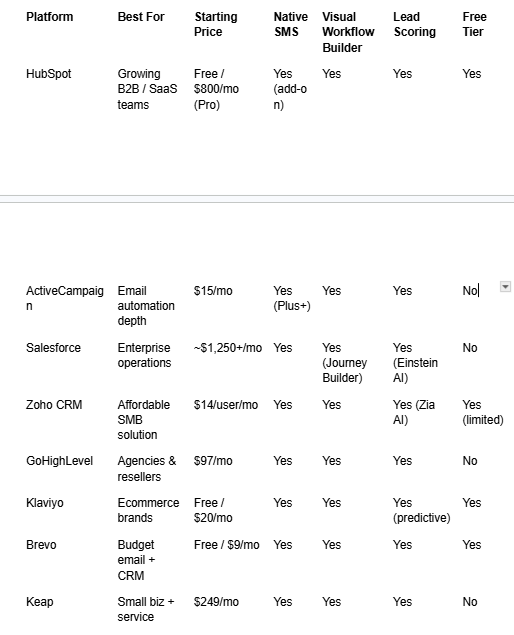
Side-by-Side CRM Marketing Automation Comparison — Pricing, Features & Best Fit
Here's a condensed comparison to help you evaluate at a glance:
Which CRM with Marketing Automation Is Right for Your Business?
Picking the right platform isn't about finding the "best" tool in the abstract, it's about finding the best fit for your specific business model, team size, budget, and growth trajectory. Here's how to think about it by segment.
Best CRM Marketing Automation for B2B SaaS and Service Companies
B2B businesses have a fundamentally different automation challenge than ecommerce. Your sales cycles are longer, your deals are higher value, and the relationship between marketing activity and revenue attribution is more complex. What you need is a platform that excels at lead nurturing, lead scoring, and seamless handoff between marketing and sales.
HubSpot is the default recommendation here, its native alignment between marketing campaigns, contact records, and deal pipeline is unmatched at the mid-market level. For companies further up the enterprise curve, Salesforce Marketing Cloud with Pardot is the most powerful combination available.
ActiveCampaign is the right call if your primary channel is email and your budget doesn't stretch to HubSpot Pro, its B2B automation depth rivals tools costing significantly more.
For B2B marketing automation platforms specifically focused on account-based marketing (ABM), also evaluate Marketo (Adobe), which the Forrester Wave has consistently rated as a leader in B2B marketing automation for enterprise organisations.
Key capabilities to prioritise for B2B:
Long-sequence email drip campaigns with conditional branching
Lead scoring models that combine demographic fit with engagement behaviour
Pipeline management that updates automatically based on marketing signals
Revenue operations (RevOps) reporting connecting campaign spend to closed revenue
Sales + marketing alignment features: shared contact records, deal notifications, handoff workflows
Best CRM with Automation for Small Businesses and Startups on a Budget
Small businesses and early-stage startups have a different set of constraints: limited time, limited budget, and usually no dedicated marketing operations person. The worst thing you can do is buy a platform so complex it never gets properly set up.
Zoho CRM is the strongest value play, especially if you bundle it within Zoho One, which gives you a complete business operating system for a fraction of what you'd pay for HubSpot's equivalent.
Brevo (formerly Sendinblue) is worth serious consideration if email and SMS are your primary channels, its free tier is genuinely functional and its paid plans remain among the most affordable in the market.
For small businesses that want simplicity above all else, Keap (formerly Infusionsoft) was rebuilt specifically for small business owners who want powerful automation without enterprise complexity. The setup is guided, the templates are practical, and the support is strong.
Marketing automation for small businesses should prioritise:
Quick time-to-value, you should be running your first automation within a day or two of signing up
Templates for common sequences (welcome series, lead nurture, re-engagement)
Affordable SMB marketing automation pricing that doesn't penalise you for growing your list
Simple reporting that shows what's working without requiring a data analyst
How to Choose the Right Marketing Automation CRM — A 5-Step Decision Framework
Regardless of your business size, this process cuts through the noise and gets you to the right decision faster:
Step 1: Define your primary use case. Are you primarily nurturing B2B leads toward a sales call? Running ecommerce campaigns? Managing agency clients? Your use case should eliminate at least half the platforms on any list before you read a single feature comparison.
Step 2: Map your current tech stack. List every tool you currently use, your email platform, landing page builder, ad platforms, helpdesk. Look for a CRM that integrates natively with the tools you won't replace, and replaces the ones that are redundant.
Step 3: Set a realistic budget including implementation. Software cost is only part of the picture. Factor in setup time, potential consultant fees, and ongoing management. A $300/month platform that takes six months to configure properly may cost more than a $600/month tool that's running in two weeks.
Step 4: Run a structured trial. Every platform on this list offers a free trial or free tier. Before committing, build one complete automation workflow, from lead capture through to sales notification. If you can't build that workflow intuitively, it's not the right tool for your team.
Step 5: Evaluate reporting quality. Ask yourself: can I see which specific campaign drove which specific deal? If the answer is no after a two-week trial, walk away. CRM ROI tracking is only possible when marketing and pipeline data are genuinely connected.
What Budget Should You Allocate for a Professional CRM Marketing Automation Platform in 2026?
Budgeting for a professional platform depends heavily on your company size and ambition — but here are realistic benchmarks based on current market pricing:
Startups and solopreneurs (up to 1,000 contacts): $0–$50/month. HubSpot free, Brevo free, Klaviyo free tier, or Zoho CRM Standard all work at this level.
Small businesses (1,000–10,000 contacts, 1–5 users): $50–$300/month. ActiveCampaign Plus, Zoho Marketing Plus, or Brevo Business cover this range well.
Growing mid-market teams (10,000–100,000 contacts, 5–20 users): $300–$1,500/month. HubSpot Marketing Hub Pro, Klaviyo at scale, or GoHighLevel Agency Pro.
Enterprise (100,000+ contacts, complex multi-channel operations): $2,000–$15,000+/month. Salesforce Marketing Cloud, Marketo (Adobe), or HubSpot Enterprise.
The most important thing to remember: the cheapest platform is rarely the most cost-effective one. A platform your team actually uses and that drives measurable pipeline growth delivers exponentially more value than a cheaper tool that collects dust after the first month.
Frequently Asked Questions About CRM Systems with Marketing Automation
Is There a Free CRM with Built-In Marketing Automation Available in 2026?
Yes, several credible options exist, though with limitations. HubSpot's free CRM is the most well-known and genuinely includes basic automation, contact management, email sending, and deal tracking at no cost. Brevo offers a free tier with up to 300 emails/day and basic automation. Zoho CRM has a free plan for up to three users. Klaviyo is free for up to 250 contacts.
The important caveat: free tiers are designed to give you a taste of the platform, not run a full marketing operation. Expect limits on contacts, sends per month, number of automations, and access to reporting features. They're ideal for early-stage testing or validating whether a platform suits your workflow before committing to a paid plan.
For businesses serious about growth, investing in even a basic paid plan, often $15–$50/month unlocks the features that make the platform genuinely useful. Think of the free tier as a CRM automation free trial that never expires, not a long-term solution.
Can a Small Business Use the Same CRM Automation Platform as an Enterprise?
Technically yes but it rarely makes sense to. Enterprise platforms like Salesforce Marketing Cloud and Marketo (Adobe) are architected for organisations with dedicated marketing operations teams, large budgets, and complex multi-channel programs. Deploying them in a small business context creates a mismatch between the platform's complexity and your team's capacity to use it.
The more practical answer is that platforms like HubSpot and Zoho CRM scale credibly from small business to mid-market, so you can start on an affordable plan and grow into more advanced features over time without migrating to a new platform. ActiveCampaign follows a similar model.
For most small businesses, the right philosophy is: start with the tool that gets you moving fast, not the tool with the longest feature list. You can always migrate upward as your operation matures. The best CRM and marketing automation for small business is the one your team will actually use consistently, not the most impressive one in a demo.
The Bottom Line — Stop Running Marketing and Sales as Two Separate Operations
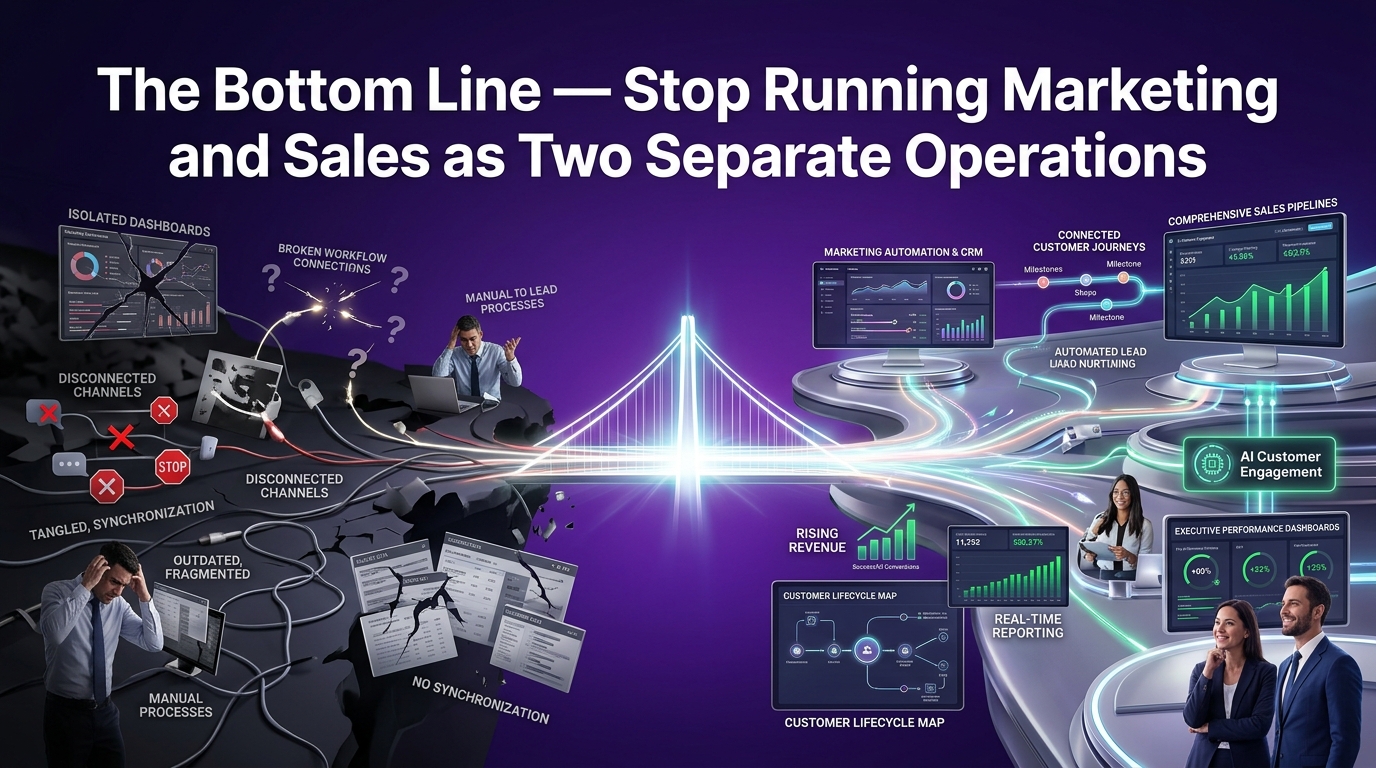
In 2026, the businesses growing fastest aren't necessarily the ones with the biggest marketing budgets or the largest sales teams. They're the ones whose systems are connected, where every marketing touchpoint informs the sales conversation, and every sales outcome feeds back into smarter marketing.
The platforms covered in this guide, from HubSpot and ActiveCampaign to Zoho CRM, GoHighLevel, and Klaviyo, each offer a credible path to that connected operation. The right one depends entirely on your business model, your team's capabilities, and where you are in your growth journey.
If you're ready to stop stitching together disconnected tools and start running a genuinely unified CRM marketing automation operation, the smartest next step is to pick one platform, run a structured trial with a real workflow, and measure what changes in your pipeline over 30 days.
At CRM Automates, we help businesses across the USA implement, configure, and optimise CRM systems with built-in marketing automation, so you spend less time managing software and more time closing deals. Whether you're evaluating your first platform or migrating off a system that's outgrown your needs, our team can walk you through the options that make sense for your specific situation.
Explore how we work or get in touch at crmautomates.com — and take the guesswork out of your next platform decision.
