Marketing Automation vs CRM: What Actually Runs Your Revenue (2026)
You've probably heard someone say "just automate it" — meaning, let the software handle it. But when you dig into which software, the answer splits into two very different systems: a CRM and a marketing automation platform. Choosing the wrong one, or running them in the wrong order, is one of the most expensive mistakes growing businesses make in 2026.
This guide breaks down what each system actually does, where they overlap, where they don't, and what the right decision looks like across different business types and revenue stages. No vendor fluff. No pitch decks. Just a clear framework so you can stop guessing and start building.
What Is a CRM, and What Does It Actually Manage?
A CRM — Customer Relationship Management system — is a database with workflow logic built around it. At its core, it stores contact records, tracks where leads are in your pipeline, logs every interaction, and helps your team manage relationships at scale without things slipping through the cracks.
The word "relationship" is doing a lot of work there. A CRM doesn't send your emails for you. It doesn't write your sequences or fire off texts when someone visits a pricing page. What it does is give you a single place to see who every contact is, where they are in your sales process, and what has happened between you.
Salesforce, HubSpot CRM, Zoho CRM, and GoHighLevel's CRM module are the most widely used platforms across the US and Canadian small-to-mid-market. Each includes pipeline management, contact records, activity tracking, and some level of task automation — but the sophistication varies significantly by platform and plan.
What a CRM Does Well
A well-configured CRM handles the things your sales team needs to stay organized and close deals. It stores and organizes every contact and company record in one place. It tracks deal stages and pipeline movement so nothing gets lost. Every touchpoint — calls, emails, notes, meetings — gets logged against the right contact. Leads get assigned to reps, ownership is clear, and stale deals get surfaced before they die quietly.
It also gives you revenue forecasting. You can see what's in your pipeline, how long deals typically take to close, and where the bottlenecks are in your sales process.
What a CRM Does Not Do on Its Own
This is where most people get confused — and where money gets wasted.
A CRM does not generate or nurture leads automatically. It doesn't run multi-step email sequences triggered by behavior. It doesn't send an SMS 30 minutes after a form fill, or re-engage a lead who opened your email three times but never replied. That's a fundamentally different job. And it belongs to marketing automation.
What Is Marketing Automation — and Why It's Not Just "Email Blasts"
Marketing automation is the layer of software that handles triggered, behavior-based communication at scale. It watches what leads and contacts do — open an email, click a link, book a call, visit a page — and responds automatically based on rules you've built in advance.
Here's the simplest way to put it: your CRM tracks what happened. Marketing automation acts on what happened.
A proper marketing automation system runs multi-step drip sequences triggered by time or behavior. It scores leads based on engagement level and routes the hottest ones to your sales team automatically. It fires SMS messages, emails, and voicemail drops without anyone touching a keyboard. It handles appointment reminders, post-booking nurture, win-back campaigns for dormant contacts, and review request sequences after a job is complete.
Platforms like ActiveCampaign, Klaviyo, and Marketo were built specifically for this function. GoHighLevel, which has become one of the fastest-growing platforms in the US agency and home services market as of 2025, combines both a CRM and a marketing automation engine in a single environment — a distinction that matters more than most buyers realize before they start comparing tools.
The Real Difference: Database vs. Engine
Here's the framing that clears up most of the confusion in this debate.
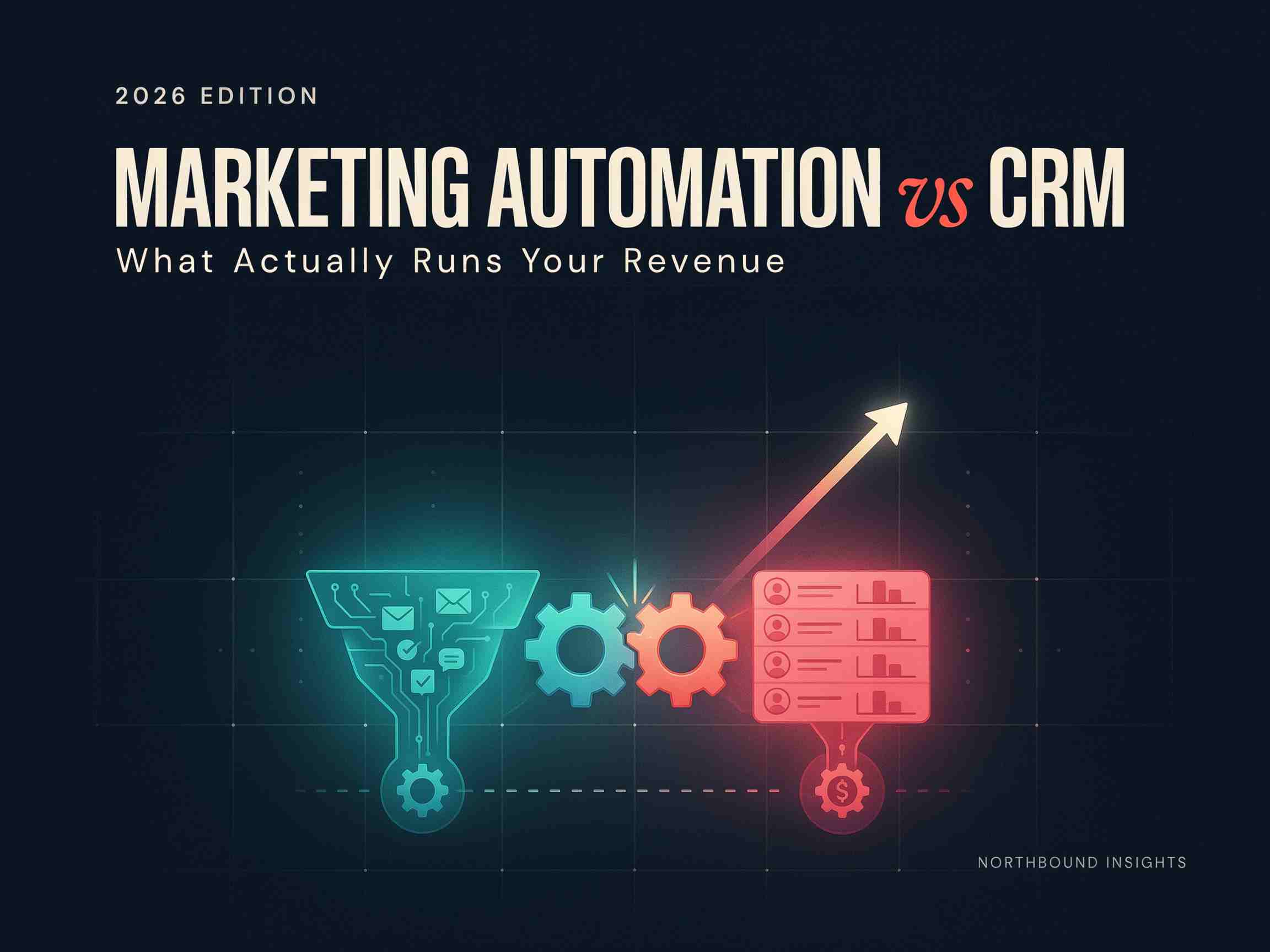
Your CRM is your database of relationships. It knows who your leads and clients are, and what has happened between you. Your marketing automation platform is your action engine. It knows what to do next — and executes it automatically based on behavior, timing, and the rules you've set.
These are not competing systems. They're different layers of the same revenue machine.
The confusion happens because many tools now include elements of both — and vendors use the terms interchangeably in their own marketing copy, which helps no one trying to make a clear decision. The fact that your CRM can send a welcome email doesn't make it a marketing automation platform. The fact that your automation tool stores contact records doesn't make it a CRM.
CRM owns the relationship record. Marketing automation owns the next action.
When you understand that, the rest of the decision gets considerably easier.
CRM Automation: When Your CRM Starts Acting Like a Marketing Tool
This is where the line blurs — and where most businesses either waste money or miss opportunity.
CRM automation refers to workflow logic inside your CRM. It's the difference between a passive database and an active system. When your CRM automates, it can do things like automatically assign leads to a rep when they hit a certain pipeline stage. It can send a task reminder when a deal hasn't moved in five days. It can trigger an internal notification when a high-value contact re-engages, or update a deal stage when a proposal is sent.
Notice what all of those examples have in common. They're internal. They manage your team's processes and your pipeline logic. They don't talk to your leads. They don't communicate with your customers. That's a critical distinction.
Even a well-configured CRM with strong automation rules still can't replace a dedicated marketing automation system for lead nurture. It manages what happens after the sales conversation starts — not what drives a lead toward that conversation in the first place.
Teams in service businesses — HVAC, roofing, marketing agencies, consulting practices — frequently confuse these two systems and end up with a CRM that's been over-engineered to do things it was never designed to handle. In working with GoHighLevel sub-accounts across service businesses in the US and Canada, the most common pattern is under-built marketing automation paired with over-complicated pipeline stages. The fix is almost always the reverse of what the team initially tried.
GoHighLevel Automations: When One Platform Does Both
GoHighLevel occupies a genuinely unique position in this conversation because it's both a CRM and a marketing automation platform in one. That's not a marketing claim — it's a functional reality.
The platform natively handles full CRM pipeline management with custom stages, multi-step automation workflows triggered by behavior, time, form fills, or pipeline movement, and SMS, email, voicemail drops, Facebook Messenger, and Google Business Profile messaging — all automated. Two-way conversations are tracked directly inside the contact record, so nothing lives in a separate inbox somewhere. Calendar and appointment booking come with automated pre- and post-sequences built around the booking event. Lead scoring, contact tagging, and AI-driven conversation workflows round out the stack — the last of which expanded significantly in GHL's 2024–2025 platform updates.
For agencies managing multiple clients, HVAC companies running high-volume lead campaigns, or coaches managing a subscriber base alongside a sales pipeline, GHL removes the need to stitch together separate tools: a CRM like Salesforce, an email platform like ActiveCampaign, and an SMS layer like Twilio. That consolidation has real cost and operational implications.
What the Cost Difference Actually Looks Like
Running separate tools — a standalone CRM plus a dedicated marketing automation platform — can reach $300 to $800 or more per month for a small team, before accounting for setup costs, integration maintenance, or the ongoing friction of keeping contact data synchronized across systems. GoHighLevel consolidates both into plans starting around $97 to $297 per month depending on configuration, with agency-tier plans available for multi-client environments.
Always verify current pricing directly on each platform's official website before making purchasing decisions, as rates change frequently across all these tools.
But the more important number isn't the monthly cost. It's what happens when contact data, pipeline stages, conversations, and automation logic all live in the same place. When they're fragmented across separate tools, you lose visibility at every integration point. Leads fall through the gaps not because the software is bad — but because it's disconnected.
Which One Does Your Business Actually Need First?
This is the question most comparison articles never directly answer. So here's a clear framework.
Start with your CRM first if you have an active sales team managing multiple leads at once. If your revenue cycle involves several conversations before a deal closes, or if pipeline visibility and deal tracking are your biggest gaps, the CRM is the right foundation. Lead management is your bottleneck, not lead volume.
Start with marketing automation first if leads are coming in but most of them go cold before they ever speak to anyone. If your follow-up is manual and inconsistent, or if you have a repeatable offer and need to scale the communication around it without adding headcount, automation is the higher-leverage starting point. You have a volume problem, not a pipeline visibility problem.
Use both — integrated — if you're past the early stage. Most growing businesses beyond the $500K mark need leads to flow automatically from initial capture through consistent nurture into a managed sales pipeline where a human takes over at the right moment. If you're running paid traffic, you need both the automated follow-up layer and the rep-managed pipeline layer working together.
For most small and mid-sized businesses in the US running under $5M per year, a platform like GoHighLevel solves both problems without the integration overhead of separate tools. At the $10M-plus level, enterprise CRMs like Salesforce with a dedicated marketing automation layer — Pardot, Marketo, or HubSpot Marketing Hub — tend to make more sense, because the reporting depth and customization requirements become harder for all-in-one platforms to match at that scale.
The Mistakes That Cost Businesses the Most
Most articles on this topic stop at definitions. Here's what actually goes wrong in practice.
Mistake 1: Building CRM pipelines before building follow-up sequences.
This is the single most common error. Teams spend weeks designing their pipeline stages — naming them, color-coding them, arguing about how many there should be — and then wonder why deals stall after the first conversation. The pipeline tells you where leads are. Automation is what moves them forward. Build the sequences first, then build the pipeline around them.
Mistake 2: Treating automation as a set-it-and-forget-it system.
Marketing automation degrades. Emails drift toward spam folders. SMS templates go stale. Sequences that converted at a healthy rate 12 months ago don't produce the same results in 2026 because audience behavior changes, deliverability rules tighten, and your offer itself evolves. Someone needs to own the ongoing optimization — not just the initial build.
Mistake 3: No lead scoring logic.
Not every lead deserves the same follow-up intensity. Without scoring — even a simple tag-based version — your automation treats someone who idly clicked a Facebook ad the same as someone who booked a call, read three emails, and visited your pricing page twice. That wastes sequences, burns contacts, and makes your best leads feel like they're being ignored while your team chases the wrong people.
Mistake 4: Disconnected data between separate tools.
When your CRM and your marketing automation platform are two different tools connected by Zapier or a similar integration layer, every connection point is a potential failure. A contact who books a call doesn't always get removed from the nurture sequence they were in. A lead who unsubscribed from email still gets an automated text. These aren't edge cases — they're daily occurrences for businesses running fragmented stacks. One platform handling both functions eliminates the problem entirely.
The Scale Factor: How the Right Answer Changes as You Grow
Most comparison content online is written for one revenue stage and quietly pretends the recommendation applies to everyone. It doesn't.
Under $500K per year, most businesses don't need a sophisticated CRM. A simple pipeline view and strong automated follow-up handles the job. GoHighLevel or a lighter tool like Pipedrive with an email automation layer works well here. The priority is speed of follow-up and consistency of nurture, not pipeline complexity.
Between $500K and $3M, the CRM starts earning more weight. You likely have reps or a small team, deals are larger and longer, and pipeline visibility genuinely matters for forecasting and accountability. This is the range where GoHighLevel earns its keep as an all-in-one — or where HubSpot's mid-tier plans start making sense depending on your tech comfort and team size.
From $3M to $10M, marketing automation becomes the primary growth lever. You're running paid campaigns at meaningful volume, managing large contact lists with multiple segments, and need sophisticated behavioral triggers and audience segmentation. Standalone tools like ActiveCampaign, HubSpot Marketing Hub, or Klaviyo for e-commerce can pull ahead here in terms of depth.
Above $10M, the CRM becomes the system of record for the entire revenue function. Salesforce dominates at this level for a reason — the customization depth, native reporting, and integration ecosystem are unmatched. Marketing automation runs on top of it through Pardot, Marketo, or HubSpot, managed by dedicated revenue ops staff who treat both systems as full-time responsibilities.
Making the Decision: Six Questions That Cut Through the Noise
Before buying or rebuilding anything, work through these questions honestly.
First: do you have a defined offer with a repeatable sales process? No software fixes an unclear value proposition. Get that right first, or automation just accelerates the wrong thing.
Second: where are most of your leads actually dropping off — before they ever speak to someone, or after the first conversation? The answer tells you whether automation or pipeline management is the higher-priority fix.
Third: do you have a team managing leads, or is it just you? A solo operator and a team of three reps have very different CRM needs.
Fourth: are you paying for a CRM that nobody uses consistently? This is more common than any vendor wants to admit. A CRM that isn't being used is not a CRM problem — it's an adoption and process problem that a better platform won't solve.
Fifth: is your current follow-up speed under five minutes for new inbound leads? Response time under five minutes is one of the highest-leverage changes most service businesses can make. If you're not there, automated follow-up is your single highest ROI starting point — above almost everything else.
Sixth: do your marketing and sales data live in the same place, or do your teams operate from different systems? If they're siloed, you're making decisions on incomplete information — and your automation and your CRM are probably contradicting each other on a daily basis.
If you're already on GoHighLevel and your automations are half-built, your pipeline has no real logic behind it, and your follow-up sequences were configured by a freelancer who's no longer reachable — that's not a platform problem. That's a systems execution problem. The answer isn't a new tool. It's someone who knows what a properly built GHL environment actually looks like and can audit what you have.
CRM Automates offers a free GHL audit call — sub-account by sub-account, no pitch, no pressure. You leave with a clear picture of what's broken and what to fix first.
The Bottom Line
Marketing automation and CRM aren't competitors. They're collaborators. One stores and manages your relationships. The other drives them forward automatically. The businesses that grow fastest have connected both into a system where every lead gets immediate follow-up, consistent nurture, clear pipeline visibility, and a human touchpoint at exactly the right moment in the process.
The platform question matters less than the execution question. GoHighLevel gives you both tools in a single environment — but a misconfigured GHL account doesn't outperform a well-built HubSpot setup just because the feature list is longer. The difference between a CRM that collects dust and an automation engine that generates revenue every week comes down to setup quality and ongoing management. Not the logo on the login screen.
Pick the right system for your current stage. Build it properly. And if it's already built but not delivering — find out exactly why before you tear it down and start over.
If you're comparing tools, the framework above gives you a clear starting point. If you're already on GoHighLevel and it's not performing the way it should, book a free audit with the CRM Automates team. Thirty minutes. No obligation. You'll know exactly what's broken, what it's costing you, and what the right expert would fix first.
Good systems don't just save time — they compound revenue.
FAQ SECTION
Q1: What is the difference between marketing automation and a CRM?
A CRM manages your contact records, pipeline stages, and sales team activity — it's the system of record for your relationships. Marketing automation handles behavior-triggered communication: emails, texts, and follow-up sequences that run automatically based on what a lead actually does. They serve different functions and work best together. Most growing businesses need both, and platforms like GoHighLevel combine them into a single environment so data stays connected.
Q2: Can a CRM replace marketing automation?
Not fully. Most modern CRMs include basic automation features — task creation, stage-based notifications, simple email triggers — but they're not built to run multi-step behavioral sequences, lead scoring models, or high-volume SMS campaigns. For proper lead nurture and automated follow-up at scale, dedicated marketing automation is still required, unless you're using a platform like GoHighLevel that includes both functions natively.
Q3: What does CRM automation actually mean?
CRM automation refers to workflow logic built inside your CRM — things like automatically assigning leads to reps, sending internal alerts when a deal goes stale, updating pipeline stages when a task is completed, or triggering a follow-up reminder after a period of no activity. It improves your internal sales process and keeps your team accountable, but it does not replace external marketing automation that actually communicates with your leads and customers.
Q4: Is GoHighLevel a CRM or a marketing automation tool?
GoHighLevel is both. It combines a full CRM pipeline and contact management system with a marketing automation engine that handles email sequences, SMS workflows, voicemail drops, appointment reminders, and behavioral triggers — all within a single platform. That's what makes it particularly effective for agencies, home service businesses, and small-to-mid-sized companies in the US and Canada who don't want to manage multiple disconnected tools.
Q5: What are the best GoHighLevel automations to build first?
The highest-value GoHighLevel automations for most service businesses are: an immediate lead response sequence — a text or email firing within five minutes of a form fill; a missed call text-back so inbound callers get an automatic response if no one answers; appointment confirmation and reminder sequences to reduce no-shows; and a re-engagement campaign for leads who went cold after initial contact. These four automations address the most common revenue leakage points in any service business pipeline.
Q6: Should I buy a CRM or marketing automation software first?
It depends on your biggest bottleneck. If leads are coming in but not converting because follow-up is slow or inconsistent, start with marketing automation. If you have a team handling leads manually and need visibility into pipeline health and deal tracking, start with a CRM. If you're starting fresh and under $5M in annual revenue, a platform that handles both — like GoHighLevel — is usually the most efficient starting point because it eliminates the integration layer entirely.
Q7: How does lead scoring work in marketing automation?
Lead scoring assigns points to contacts based on their behavior — opening emails, clicking links, visiting key pages, booking calls, or engaging with SMS messages. Contacts who accumulate a high score signal strong buying intent and get routed to your sales team or a higher-priority follow-up sequence automatically. It prevents your team from wasting time on low-intent contacts while high-intent leads sit unworked. GoHighLevel supports tag-based and action-based scoring within its automation workflow builder.
Q8: What's the biggest mistake businesses make with marketing automation?
Building sequences and then never touching them again. Automation degrades over time — email deliverability changes, audience behavior shifts, and sequences that converted well 12 months ago may now be hurting your domain reputation or simply producing no measurable results. The businesses that get sustained ROI from automation treat it as a living system that gets reviewed and refined on a quarterly basis, not a one-time build project that runs in the background forever.
Q9: Can marketing automation work without a CRM?
Technically yes — but it's significantly less effective in practice. Without a CRM, you have no reliable record of where a contact stands in the sales process, no visibility into which deals are actually moving, and no clean handoff point where human follow-through takes over from automated communication. Marketing automation works best as the front-end engine that feeds qualified, nurtured leads into a CRM where your sales team or pipeline logic picks up the conversation at the right moment.
Q10: How much does it cost to run both a CRM and marketing automation?
Costs vary significantly by platform and contact volume. Running separate tools — for example, Salesforce Essentials at roughly $25 per user per month combined with ActiveCampaign at $49 to $149 per month — can easily reach $300 to $600 per month for a small team, before accounting for setup time and integration maintenance. GoHighLevel consolidates both into a single plan starting around $97 per month for a single account. Always verify current pricing on official websites before making any purchasing decisions, as rates change. And factor in setup and ongoing management costs — a poorly configured automation system has a negative ROI regardless of what the monthly platform fee is.