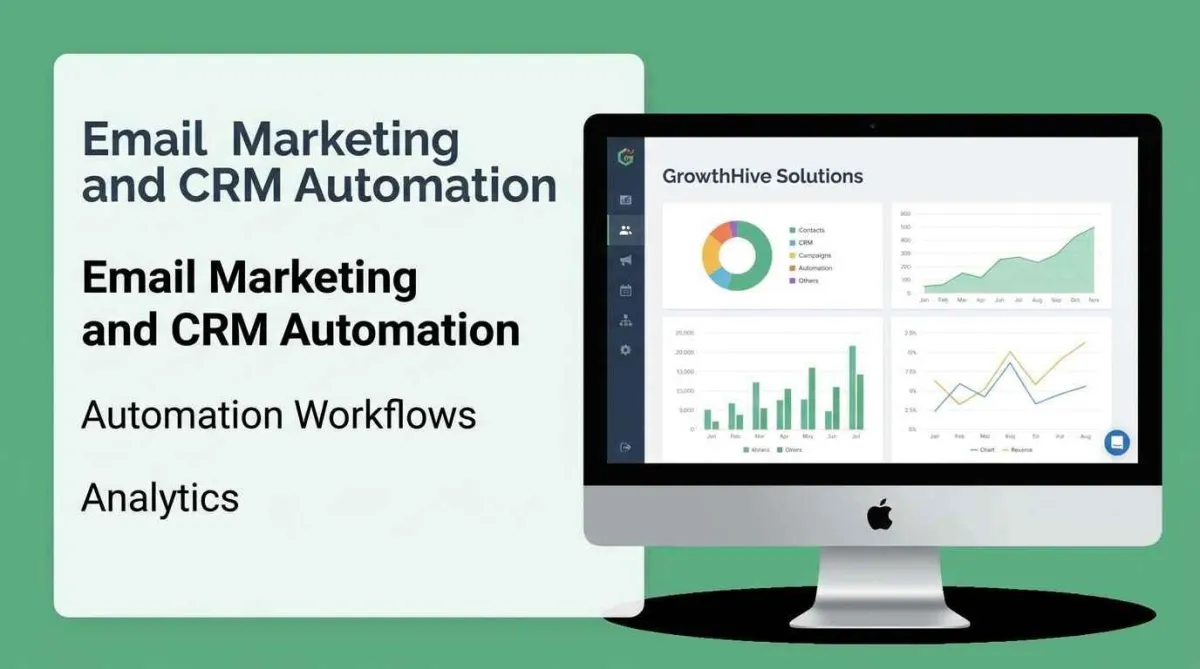
Email Marketing & CRM Automation Tools: Pick the Right Platform the First Time (2026)

Email Marketing and CRM Automation Tools in 2026: What the Fine Print Hides
Your marketing lead just forwarded you a Brevo comparison chart. Your ops person swears by HubSpot. Your budget says "not another SaaS subscription." And somewhere in your stack, Mailchimp is quietly billing for 1,200 contacts you haven't emailed in eight months.
This is the normal chaos of picking email marketing and CRM automation tools in 2026.
Too many options. Too many hidden cost triggers. Very little honest talk about what breaks after month three.
The real question isn't "which tool is best?" It's which one won't punish you when your contact list doubles, your automation needs get real, and your team actually has to use it every day.
This guide answers that. No vendor landing page language.
What a Unified Email and CRM Platform Actually Does
Most teams run email marketing and CRM in separate silos.
The email tool sends newsletters. The CRM tracks deals. They rarely talk well.
A unified platform connects those worlds. A contact opens an email, clicks a product link, and visits your pricing page. All three actions feed back into the CRM record automatically. The sales team sees the engagement. The marketing team sees the pipeline stage. Both systems draw from one source of truth.
Sounds obvious. But many platforms that claim to be unified are really just two products held together by a thin API connection. That connection drops data whenever a sync window closes.
HubSpot built its brand around genuine CRM-native email automation. ActiveCampaign stitched a CRM into an existing email engine and did a solid job. Mailchimp bought a CRM and bolted it on. The seams still show.
That spectrum matters.
A platform that treats CRM as an afterthought will never give you the behavioral triggers, pipeline-aware segmentation, or closed-loop revenue attribution that justify the monthly bill. Backlinko's January 2026 research confirms that 76% of companies now use some form of marketing automation. Your competitors are automating. The ones who aren't are losing leads to those who are.
The Platforms That Actually Earn Their Keep
Not every tool belongs on a shortlist. These six earned their spots.
HubSpot Marketing Hub remains the benchmark. Forms, email sequences, deal stages, revenue attribution: it all lives inside one ecosystem. The free CRM is genuinely useful. The visual automation builder supports complex branching logic that most competitors gate behind enterprise tiers.
The cost is brutal.
Marketing Hub Professional starts at890permonth.RequiredProfessionalonboardingaddsanother890permonth.RequiredProfessionalonboardingaddsanother3,000. Seats run45to45to75 each per month. For a 10-person marketing team, real spend easily crosses $1,300 per month before you send a single email.
HubSpot wins for mid-market B2B teams that can afford the premium. It is wrong for a five-person startup running simple drips to 2,000 contacts.
ActiveCampaign takes the opposite approach. Its visual workflow builder handles triggers, conditions, and actions with depth you would normally need a higher HubSpot tier for. Site tracking, event-based triggers, and predictive sending come standard even on the $15 Starter plan. The automation recipes library can cut setup time from hours to minutes.
The trade-off is a steep learning curve. New users routinely report feeling overwhelmed in month one. There is no proper free plan, just a trial. Support quality varies by tier.
For SMBs needing advanced behavioral automation without the HubSpot premium, ActiveCampaign is often the strongest pick.
Mailchimp still serves as the most common entry point. Its free tier handles up to 500 contacts. The interface is polished, templates are generous, and the AI Creative Assistant generates subject lines and content drafts quickly.
Trouble hits at scale.
CRM features feel added, not native. Automation logic is linear where competitors offer branching. And the pricing model gets aggressive fast. Mailchimp charges per contact per list. A single subscriber appearing on three separate lists is billed three times. A growing business with 5,000 unique contacts across multiple segments can see costs quietly double.
Mailchimp works for simple campaigns with light segmentation. It is not where you build a genuine CRM automation strategy.
Klaviy odominates ecommerce for a reason. It natively integrates with Shopify, Woo Commerce, Magento, and Big Commerce. Real-time purchase history, browse behavior, and cart activity feed directly into segmentation logic. Predictive analytics forecast customer lifetime value and churn probability. Abandoned cart flows, post-purchase sequences, and win-back campaigns work out of the box.
The platform is purpose-built for product-based businesses. B2B teams with long sales cycles and complex account hierarchies will find it limiting. For online retailers, the numbers speak loudly. Litmus 2026 data shows ecommerce email returns an average of $45 for every dollar spent.
Brevo (formerly Sendin blue) sidesteps the per-contact pricing trap. It charges by email volume, not contact count. The free tier includes unlimited contacts and 300 emails daily. Paid plans add CRM deal pipelines, SMS, transactional email, and live chat.
Automation depth is modest compared to Active Campaign. The CRM is functional rather than powerful. But for a small team that wants email, SMS, and basic deal tracking without the per-contact pricing anxiety, Brevo's model makes mathematical sense.
Crm Automates targets a specific operator: coaches, consultants, and service businesses that need client onboarding, booking, funnel building, and email follow-up in one place. Platforms like GoHighLevel (accessible through CRM Automates) consolidate what would otherwise require four to five separate subscriptions into a single instance. Landing pages, appointment scheduling, and automated email and SMS sequences all operate from that one hub.
This vertical approach cuts tool sprawl and can reduce monthly SaaS spend by 60% or more for a solopreneur or small agency. The trade-off is less flexibility outside that use case. You would not pick it for an enterprise B2B pipeline with 50,000 contacts and complex lead scoring.
What You Actually Pay at 3 Users and 5,000 Contacts
HubSpot Marketing Hub Pro
Base price: ~$890/month
3 user seats add: ~$135/month
Total monthly cost: ~$1,025/month before onboarding
Required Professional onboarding: ~$3,000 one-time fee
Estimated first-year total: ~$15,300
Hidden costs:
Per-seat fees
Mandatory onboarding charges
ActiveCampaign Plus
Cost for 5,000 contacts and 3 users: ~$125/month
No mandatory onboarding fee
No per-seat surcharge
Estimated annual total: ~$1,500
Trade-offs:
Steeper learning curve
No free tier
Mailchimp Standard
Typical cost for 5,000 contacts: ~$100/month
Costs can rise to ~$150–$200/month with duplicate list billing
Important limitation:
One email on multiple lists may count as multiple contacts
Klaviyo
Estimated cost at this scale: ~$150/month
SMS marketing adds: ~$15–$35/month
Best suited for:
Brands sending emails frequently
Brevo Business
5,000 contacts + 20,000 emails/month: ~$65/month
Unlimited contacts included
Pricing based mainly on send volume
Best value when:
Audience size is large
Email frequency is low
Crm Automates via GoHighLevel
Basic plan: ~$97/month
Unlimited agency plan: ~$297/month
Includes:
Unlimited contacts
Unlimited users
Major advantage:
No per-contact pricing penalties
Predictable flat-fee scaling for agencies
Key Pricing Lesson
Always verify current pricing directly on each vendor’s website before buying
The pricing model matters more than the sticker price:
Per-contact pricing
Per-list pricing
Flat-fee pricing
Your costs can double quickly as your contact list grows depending on the platform structure.
The Hidden Costs No Pricing Page Mentions
]Subscription Fees Are Only the Beginning
The advertised monthly price is often just a fraction of the real cost
Hidden pricing structures can dramatically increase expenses over time
Per-Contact vs. Per-List Billing
Some platforms charge per unique contact
Others charge per list appearance
Example:
A 5,000-contact database split across 3 campaign lists may become 15,000 billable contacts
Important question to ask vendors:
Does one email on three lists count as one contact or three?
Onboarding and Implementation Costs
Mandatory onboarding fees can be substantial
Examples:
HubSpot Professional onboarding: ~$3,000
HubSpot Enterprise onboarding: ~$7,000
Data migration from legacy systems may cost:
~$2,000 to $15,000
Many businesses discover these fees only after signing the contract
Per-Seat Pricing Surprises
Pricing that appears organization-wide may actually include per-user charges
Example:
HubSpot Professional charges roughly $45–$75 per additional seat
Result:
Team growth alone can significantly increase monthly costs without adding new functionality
The Feature Tier Trap
Advanced tools are often locked behind expensive plan upgrades
Features commonly restricted to higher tiers include:
Advanced reporting
Predictive lead scoring
Custom automation
Companies may upgrade to enterprise plans just for one or two features
Often, a large percentage of the suite remains unused
Integration Maintenance Costs
Connecting multiple systems creates ongoing operational overhead
Common problems include:
Broken API connections
Failed syncs
Data inconsistencies
Example:
CRM labels a user as a “lead” while the email platform marks them as a “customer”
Hidden cost:
Team time spent troubleshooting and maintaining integrations every month
The Integration Break That Nobody Talks About
This is the failure scenario the top-ranking articles skip. And it is the single most common reason teams abandon a platform within twelve months.
In the typical integration setup, email engagement data flows from the email tool to the CRM, but only in one direction. A contact opens five emails, clicks three links, submits a form. That behavioral signal stays trapped in the email platform. The CRM still shows "sent newsletter" as the last activity.
Sync failures follow predictable causes. API rate limits throttle data flow. Field mapping errors drop certain record types. Duplicate records appear when a contact exists in both systems under slightly different email formats.
The Gartner finding is sobering. Eighty-three percent of CRM migration projects fail, exceed budgets, or cause business disruptions. The average cost of a failed migration is $427,000 including lost productivity and consulting fees.
When you evaluate platforms, ask about sync architecture. Two-way sync with conflict resolution rules is the minimum. Real-time sync beats batch. Native CRM integration, the HubSpot model, is far more reliable than a third-party connector held together with Zapier webhooks.
The Right Answer Changes With Your Business Model
A SaaS company and an ecommerce brand need different tools.
A B2B SaaS company with a six-month sales cycle needs pipeline-aware email automation, lead scoring, and CRM-native deal tracking. A single prospect might receive fifteen emails across nurture, trial onboarding, and renewal sequences. All must reflect the current deal stage. ActiveCampaign and HubSpot are built for this.
An ecommerce brand with 20,000 customers needs product-based segmentation, abandoned cart flows, and predictive purchase analytics. Klaviyo dominates here because its data model revolves around products, not companies.
A service business, whether coach, consultant, or agency, needs appointment booking, client onboarding sequences, and simple deal pipelines. Crm Automates handles these workflows through vertical platforms that prioritize the client journey over complex marketing funnels.
A solopreneur with a newsletter and a dream needs simplicity, a free tier, and drag-and-drop design. Mailchimp or Brevo fit that brief. Just know that outgrowing them is a matter of when, not if.
How Scale Changes Everything
Contact count flips the decision entirely.
At 500 contacts, Mailchimp's free tier works beautifully. HubSpot's free CRM with basic email is enough. Price is near zero. Almost any platform fits.
At 5,000 contacts, the per-contact pricing models activate. Mailchimp's list-based billing can quietly double costs. HubSpot's Starter tier feels thin, pushing you toward the Professional jump at $890 per month. ActiveCampaign's contact-based tiers stay predictable. Brevo's send-based model often becomes the cheapest if your send frequency stays under a few thousand emails monthly.
At 50,000 contacts, the math changes entirely. Per-contact pricing means monthly bills in the thousands no matter the platform. Send-based models break if you email frequently. Enterprise contracts with negotiated rates become necessary. Switching platforms at this scale is expensive, complex, and risky. Migration costs run well into five figures.
Pick a platform that can grow with you. Not one that forces a painful replat forming at 10,000 contacts.
Seven Questions to Ask Before You Sign
When you have a vendor on the call, walk through every one of these. If answers get vague, walk away.
One. If a contact exists in my CRM and my email tool under slightly different email formats, how does your platform handle the merge?
Two. When I cross 10,000 contacts, what exactly changes on my monthly bill? Show me the math for my current list today.
Three. Does your platform charge per unique contact or per list appearance? Walk me through a specific example.
Four. What data flows bidirectionally between email and CRM, and what is the sync latency?
Five. If your native integration fails, do you provide a supported fallback, or am I on my own with Zapier?
Six. Which advanced features, like reporting, predictive scoring, or multi-touch attribution, require an upgrade from the plan I am considering?
Seven. If I need to leave in eighteen months, what is the exact data export format? Show me a sample export file.
Nobody builds a perfect platform for everyone.
HubSpot is the strongest all-in-one for mid-market B2B teams, provided you can stomach the price curve. Active Campaign delivers the best automation depth per dollar for SMBs. Klaviyo owns ecommerce. Brevo sidesteps the contact-count tax. And specialized plays like Crm Automates handle vertical workflows that horizontal platforms overcomplicate.
The platform you pick matters less than whether you truly understood the pricing model, the sync architecture, and the scale ceiling before signing. Run the seven questions. Do the math at your projected twelve-month contact count.
The worst time to discover a pricing trap or a broken integration is the month your team has already migrated, trained, and committed. Do not let that be you.
FAQ Section
What is the difference between email marketing tools and CRM automation?
Email marketing tools send and track bulk emails. CRM automation tools manage customer relationships, track deals, and trigger emails based on pipeline stage or behavior. Some platforms combine both, but the quality of integration varies.
How much should a small business expect to pay for email CRM automation in 2026?
A small team with 2,500 contacts should budget50to50to125 per month for a platform like ActiveCampaign Plus or Brevo Business. One-time onboarding costs for SMB tiers range from nothing to about $500.
Why does Mailchimp get expensive as you scale?
Mailchimp charges per contact per list. A single subscriber on three separate lists counts as three billable contacts. This multiplies costs compared to platforms that charge per unique contact regardless of how you segment.
Is HubSpot worth the price for a small marketing team?
Only if you are actively using the CRM, automation, reporting, and sales hub together. If you mainly run email campaigns with light CRM needs, ActiveCampaign delivers similar automation depth at a fraction of the monthly cost.
What causes CRM and email platform integrations to fail?
API rate limits, one-way data sync, field mapping errors, and duplicate contact records are the most common culprits. Native integrations within a single platform are inherently more reliable than third-party connectors.
Can I switch platforms after six months without losing data?
Technically yes. Most platforms offer CSV export. But historical engagement records, automation workflows, and segmentation logic often do not transfer cleanly. Plan for two to four weeks of cleanup and reconfiguration.
What is Crm Automates best suited for?
Crm automates vertical-specific workflows for coaches, consultants, and service businesses. It consolidates CRM, booking, email marketing, and funnel automation into one platform, cutting tool sprawl and monthly SaaS costs for client-focused businesses.