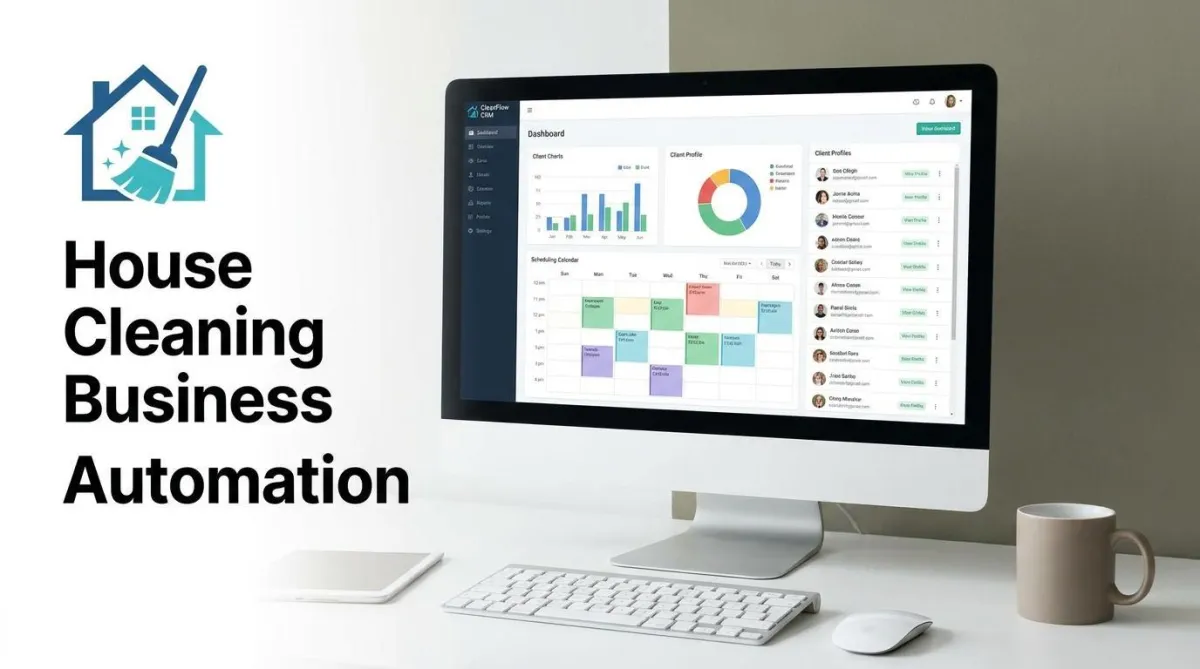
House Cleaning Business Software That Actually Works 2026
You started your cleaning business to clean homes, not to spend four hours every Sunday chasing unpaid invoices, texting appointment reminders to clients who still forget, and trying to figure out which cleaner is available next Thursday. That admin load is not a growth problem. It is a systems problem. The right house cleaning business software eliminates most of it before it reaches you. The wrong one adds complexity on top of chaos. This guide cuts through the feature lists and tells you what actually matters for residential cleaning operations in the US, Canada, UK, and Australia in 2026, who each platform fits, and where CRM automation changes the economics entirely.
What House Cleaning Business Software Is Actually Supposed to Do
House cleaning business software is a category of tools designed to handle the operational and client management tasks that consume time without generating revenue. At its core it covers scheduling and dispatch, client communication, invoicing and payment collection, staff management, and follow-up automation.
The problem is that most software in this category handles some of these functions adequately and others poorly. A platform built for field service generally handles scheduling well and handles client nurture sequences badly. A CRM built for agencies handles follow-up sequences well and handles recurring job scheduling awkwardly. The gap between what the software does and what a residential cleaning business actually needs is where most operators lose time every week.
The honest frame for evaluating any cleaning business software is not the feature list. It is the question: how many decisions does this platform remove from my day? A tool that requires you to manually trigger follow-ups, manually update job statuses, and manually chase payment is not automating your business. It is digitizing the same manual work with a different interface.
Why Most Cleaning Business Software Falls Short for Residential Operations
Residential cleaning has a specific operational profile that generic service business software does not accommodate well. Jobs are recurring. Clients cancel with less notice than commercial accounts. Cleaners call in sick on short notice. Trust is the primary retention driver, not price. And the most valuable growth channel, referrals, runs entirely through client experience rather than advertising.
Most platforms in the cleaning software category were built for one of two audiences: large multi-location franchises or solo operators just getting started. The mid-tier residential cleaning business running three to fifteen cleaners across a defined service area falls awkwardly between those two design targets. The franchise platforms are overbuilt and overpriced. The starter tools cap out before the business does.
Platforms like Jobber, Housecall Pro, and ZenMaid dominate the residential cleaning software conversation on comparison sites in 2026. They handle scheduling and basic invoicing competently. Where they consistently fall short is in the client communication and retention layer. A client who reschedules twice gets the same automated message as a client who has been with you for three years. There is no behavioral intelligence in the follow-up. There is no triggered re-engagement when a regular client goes quiet for six weeks. The revenue that leaks through those gaps is invisible unless you are measuring it.
The Five Functions That Actually Drive Revenue in a Cleaning Business
Before comparing any software, it is worth being clear about which functions directly protect and grow revenue versus which ones are operational necessities that need to work reliably but do not differentiate your business.
Automated appointment reminders reduce no-shows. In residential cleaning operations across the US and Canada, no-show rates without reminders consistently run at 8 to 15 percent of scheduled appointments. A well-configured reminder sequence, text plus email at 48 hours and again at 2 hours, brings that below 3 percent for most operators. This single function pays for almost any software subscription within the first month.
Re-engagement sequences recover lapsed clients. A residential cleaning client who misses two consecutive bookings has a 60 percent chance of churning completely within 90 days, according to 2025 operational benchmarks published by the Association of Residential Cleaning Services International. A triggered sequence that contacts that client at day 14, day 30, and day 60 with a specific re-booking offer recovers a meaningful share of them. Most scheduling-first platforms do not support this type of behavioral trigger natively.
Review generation runs on timing. The optimal window to request a Google or Trustpilot review from a satisfied client is within two hours of job completion. After 24 hours, response rates drop by over 70 percent. Automated review requests tied to job completion status in the CRM capture this window without anyone on your team remembering to send a message.
Referral activation needs a trigger. Most cleaning businesses get referrals passively, when a happy client mentions them to a neighbor. An active referral program triggered by a positive review or a completed loyalty milestone generates three to five times more referrals than passive word of mouth. This requires a CRM that can segment clients by satisfaction signals and trigger personalized outreach, not a scheduling tool that sends the same monthly newsletter to everyone.
Upsell and service expansion happens through relationship data. A client who books standard cleans every two weeks is a natural candidate for a deep clean upsell before a holiday, a move-out clean offer when address-change signals appear, or an add-on like oven or window cleaning. Identifying those clients and triggering the right offer at the right time requires behavioral data sitting in a CRM, not just a job history in a scheduling app.
Residential Cleaning Business Software by Business Size and Need
The right platform depends significantly on where your business sits in its growth stage. A one-person operation has different constraints from a fifteen-cleaner company running in multiple suburbs of Toronto or Melbourne.
For solo operators and very small teams under five cleaners, the priority is reliability and simplicity over sophistication. ZenMaid is purpose-built for residential cleaning and handles the core scheduling, reminders, and basic invoicing without requiring significant setup time. It is not a CRM. It does not support behavioral automation. But it covers the operational layer cleanly and the learning curve is shallow. For a solo operator in the early stages, it is a reasonable starting point before the business outgrows it.
For growing cleaning businesses running five to fifteen cleaners across a defined service area, the scheduling-first platforms create a ceiling that is reached faster than most operators expect. Jobber handles scheduling and invoicing well for this tier. Housecall Pro adds some marketing features. Neither was built to manage the client relationship layer at the level that drives referrals, recovers lapsed clients, and generates reviews systematically. This is the tier where the gap between operational software and CRM automation becomes financially significant.
For cleaning businesses at fifteen-plus cleaners, multi-location operations, or franchise models, the operational complexity typically requires a dedicated scheduling and dispatch platform running alongside a CRM automation layer. Running them separately with clean integration is more effective than trying to find a single platform that does both adequately.
How CRM Automation Changes the Economics of a Cleaning Business
CRM automation is the application of behavioral triggers and workflow logic to client relationship management, meaning the system takes specific actions based on what clients do or do not do, without manual input from your team.
For a residential cleaning business, CRM automation built on a platform like GoHighLevel, configured specifically for cleaning operations, replaces the following manual tasks: sending booking confirmation and reminder sequences, following up with clients who cancel without rebooking, triggering review requests within two hours of job completion, re-engaging lapsed clients at defined intervals, sending referral program activation messages to high-satisfaction clients, and generating upsell offers based on booking frequency and service history.
The compound effect of these automations running simultaneously is not incremental. In residential cleaning operations where client lifetime value typically runs between $2,000 and $8,000 depending on frequency and service area, recovering one lapsed client per week through automated re-engagement represents $100,000 to $400,000 in protected lifetime value annually for a business with a hundred active clients.
CRM Automates builds these automation systems specifically for service businesses including residential cleaning operations across the US, Canada, the UK, and Australia. Rather than leaving operators to configure a general-purpose CRM themselves, the approach is to engineer a complete automation infrastructure built around the specific workflows of a cleaning business. The revenue protection from automated re-engagement, referral activation, and review generation typically justifies the investment within the first 90 days for cleaning businesses generating consistent recurring revenue. Verify current pricing and availability directly at crmautomates.com before making any decisions.
Cleaning Business Software for Canada, UK, and Australia: What Is Different
The residential cleaning software market has historically been built around US operations, and this creates real gaps for operators in other markets.
In Canada, particularly in provinces like Ontario, British Columbia, and Quebec, GST and PST handling requirements mean that invoicing built for US sales tax structures creates compliance headaches. Platforms that support Canadian tax configurations natively include Jobber, which has strong Canadian market penetration, and GoHighLevel when configured correctly through a specialist provider familiar with Canadian invoicing requirements.
In the UK, GDPR compliance affects how client data is stored and how marketing communications are triggered. Any CRM automation deployed for a UK cleaning business needs to operate within proper opt-in consent frameworks. GoHighLevel supports GDPR-compliant data handling when configured correctly. Operators using US-centric platforms without GDPR configuration are operating with real compliance exposure.
In Australia, the residential cleaning market is consolidating rapidly. According to IBISWorld's 2025 Australian Cleaning Services industry report, the sector grew at an annualized rate of 4.2 percent between 2020 and 2025. Platforms with strong mobile functionality matter more in Australian markets where cleaners operate across larger geographic areas than typical US suburban routes. Operationally, the timezone handling and SMS delivery through Australian carriers requires platform configuration that not all US-built tools handle out of the box.
The Real Cost of Not Having Proper Software: A Framework
Most articles on cleaning business software focus on what the software costs. The more relevant number is what the absence of proper automation costs.
A residential cleaning business with fifty active clients generating average revenue of $250 per clean, with two cleans per month per client, runs approximately $150,000 in annual revenue. Without automated re-engagement, an industry-standard 20 percent annual churn rate costs $30,000 per year in lost recurring revenue, entirely separate from the cost of acquiring new clients to replace them.
Without automated review generation, the business accumulates reviews slowly and inconsistently. Platforms with fewer than twenty recent Google reviews in competitive markets like Toronto, Melbourne, Houston, and London lose a measurable share of inbound inquiries to competitors with stronger review profiles. The customer acquisition cost difference between a business with forty reviews averaging 4.8 stars and one with twelve reviews averaging 4.2 stars is significant in markets where homeowners make decisions primarily through local search.
Without automated referral activation, the business depends entirely on passive word of mouth. An active referral program generating two new clients per month at zero acquisition cost represents roughly $5,000 to $16,000 in annual lifetime value at a 20 percent lower cost per acquisition than any paid channel.
When you add these three numbers together, the cost of absent automation in a fifty-client cleaning business commonly exceeds $50,000 per year in recoverable revenue. Framed that way, a properly configured CRM automation system is not an operating cost. It is a revenue recovery mechanism.
Conclusion
House cleaning business software in 2026 falls into two distinct categories: operational tools that handle scheduling and invoicing, and CRM automation systems that manage the client relationship layer driving retention, referrals, and reviews. Most operators need both, but the second category creates the financial impact that determines whether a cleaning business plateaus or compounds.
For solo operators and small teams, ZenMaid or Jobber covers the operational layer cleanly. For growing residential cleaning businesses in the US, Canada, the UK, and Australia where client lifetime value and referral economics matter, CRM automation built on a platform like GoHighLevel and configured specifically for cleaning operations is where the real revenue protection sits.
If your cleaning business is running on manual follow-ups and passive referrals, the gap between where you are and where a properly automated system puts you is measurable in tens of thousands of dollars annually. CRM Automates builds these systems for cleaning businesses specifically. Visit crmautomates.com to see what a complete automation infrastructure looks like for your operation.
The software you run your business on is not an admin tool. It is a revenue decision.
FAQ Section
What is the best house cleaning business software in 2026? The best house cleaning business software depends on your business size and what you need it to do. ZenMaid is purpose-built for residential cleaning and works well for smaller operations. Jobber handles scheduling and invoicing for growing teams. For client retention, review generation, and referral automation, a CRM layer built on GoHighLevel configured for cleaning operations outperforms scheduling-first platforms. Most scaling cleaning businesses need both an operational tool and a CRM automation system running together.
What does house cleaning business software typically cost? Scheduling-focused platforms like ZenMaid and Jobber run $49 to $249 per month depending on team size and feature tier. GoHighLevel for CRM automation runs $97 to $497 per month. Professional configuration of a complete automation system for a cleaning business typically adds $1,500 to $5,000 as a one-time setup cost. Always verify current pricing directly with each platform before budgeting. Total first-year investment for a properly configured system including both operational and CRM tools runs $3,000 to $12,000 for most mid-tier cleaning businesses.
Is CRM automation worth it for a small cleaning business? For a cleaning business with fewer than ten active recurring clients, scheduling software alone is adequate. Once you have twenty or more recurring clients, the revenue protection from automated re-engagement and review generation typically justifies CRM automation within 60 to 90 days. A single recovered lapsed client with a $3,000 lifetime value covers months of platform cost. The return calculation changes dramatically once the client base reaches 30 to 50 recurring accounts.
What is the difference between cleaning business software and CRM automation? Cleaning business software primarily manages operational tasks including scheduling, dispatch, invoicing, and payment collection. CRM automation manages the client relationship layer including follow-up sequences, lapsed client re-engagement, review generation, referral activation, and behavioral segmentation. Most scheduling-first cleaning platforms handle operations adequately but lack the behavioral trigger logic that drives retention and referrals. CRM automation fills that gap and is where the measurable revenue impact sits.
What cleaning business software works in Canada? Jobber has strong Canadian market penetration and handles GST and PST invoicing natively, making it the most operationally practical scheduling tool for Canadian cleaning businesses. For CRM automation in Canada, GoHighLevel configured by a specialist provider familiar with Canadian tax and SMS carrier requirements covers the client relationship layer effectively. Avoid using US-centric platforms with hardcoded US tax structures for Canadian invoicing without confirming they support Canadian provincial tax configurations.
How does automated review generation work for cleaning businesses? Automated review generation works by triggering a review request message, typically via SMS, within two hours of a job being marked complete in the CRM. This timing captures the peak satisfaction window before the client moves on to other tasks. Review request messages sent within two hours of job completion generate response rates five to seven times higher than messages sent the following day. The system identifies which clients have not yet left a review and excludes those who have, preventing repeat requests to the same person.
Can house cleaning business software integrate with QuickBooks? Most major cleaning business platforms including Jobber and Housecall Pro offer native QuickBooks Online integration for invoicing and payment reconciliation. GoHighLevel integrates with QuickBooks through Zapier or direct API connection. When evaluating any platform, confirm the integration is bidirectional, meaning job completions in the scheduling tool automatically create or update invoices in QuickBooks, rather than requiring manual export. Half-configured integrations that require manual data transfer eliminate most of the time-saving benefit.
What is the best cleaning business software for Australia? In Australia, platforms with strong mobile functionality and reliable SMS delivery through Australian carriers matter most given the geographic spread of cleaning routes. Jobber operates in Australia and handles scheduling well. For CRM automation, GoHighLevel configured through a specialist who understands Australian carrier SMS delivery and IBISWorld's data on the Australian cleaning services sector growth context performs reliably. Verify current availability and carrier compatibility directly with any platform before committing to it for an Australian operation.
How long does it take to set up CRM automation for a cleaning business? A DIY configuration of GoHighLevel for a cleaning business typically takes four to eight weeks to build and test properly. A specialist provider configuring a complete cleaning business automation system including re-engagement sequences, review generation, referral activation, and lapsed client workflows typically delivers a working system within two to three weeks. The operational benefit of faster deployment compounds quickly for businesses with fifty or more active clients where every week of delayed automation represents measurable revenue leakage.
What automations should a cleaning business set up first? Start with appointment reminder sequences, text plus email at 48 hours and two hours before each job. This single automation reduces no-shows from industry average 8 to 15 percent down to under 3 percent for most operations and typically pays for the entire platform within the first month. After reminders, add job completion review requests, then lapsed client re-engagement sequences for clients who miss two consecutive bookings. These three automations address the highest-value revenue leakage points for most residential cleaning businesses before adding more sophisticated referral and upsell workflows.