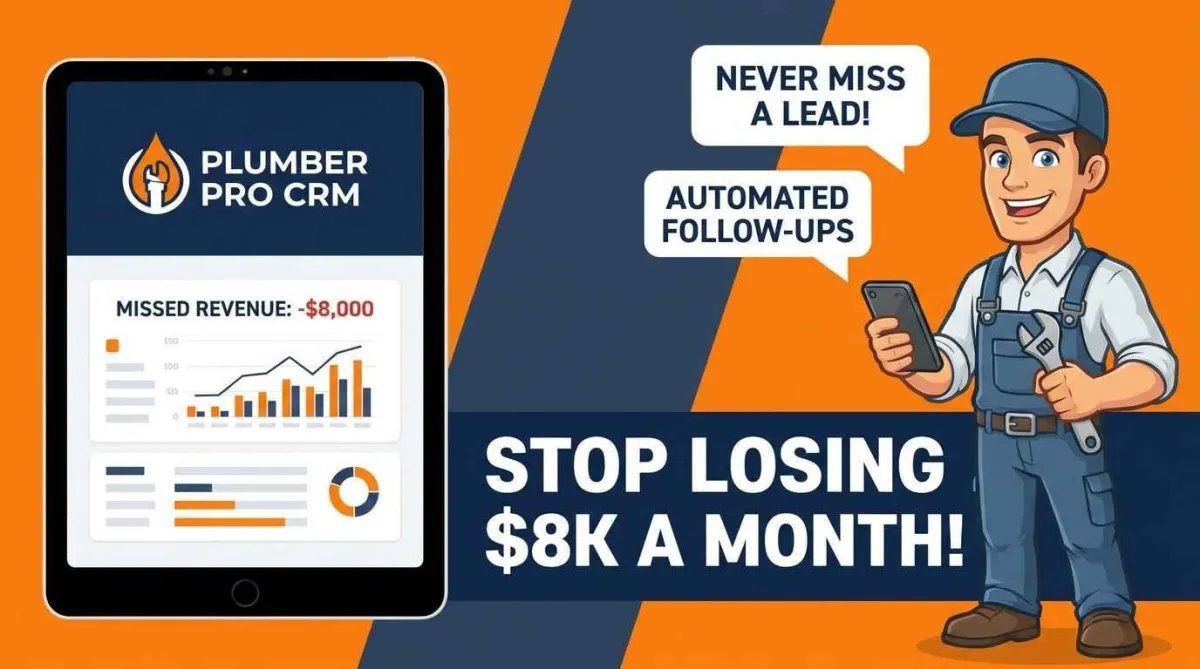
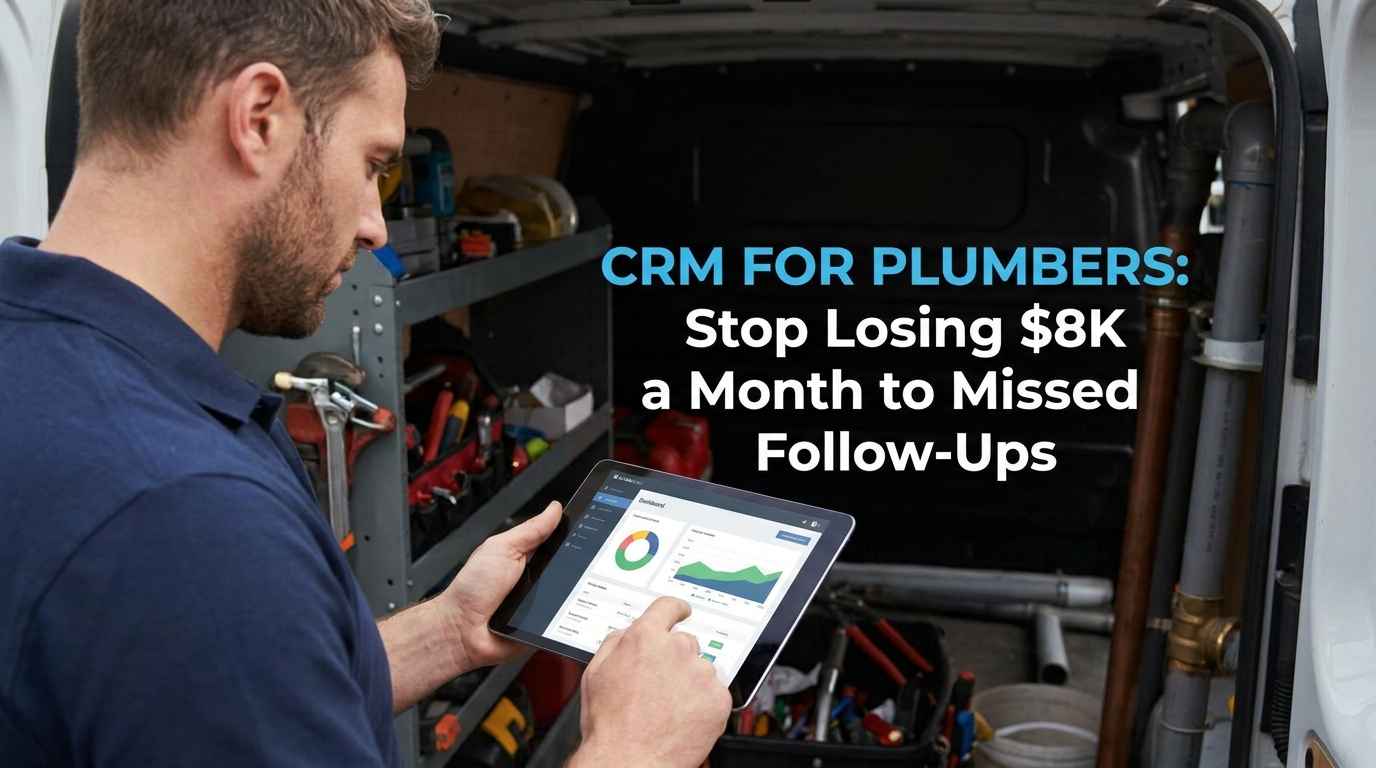
CRM for Plumbers: Stop Losing $8K a Month to Missed Follow-Ups
Here is something nobody tells plumbing business owners.
You are not losing money because of bad leads. You are not losing money because your prices are wrong or because a competitor is better than you. You are losing money because the leads you already paid for are dying in your phone, your voicemail, and your notes app before anyone follows up properly.
The average plumbing business misses 30 to 40 percent of inbound calls during working hours. Of the ones that do get answered, most get one follow-up attempt. Maybe two. After that, nothing. The customer Googles another plumber, books them, and your name never comes up again.
Multiply that by twelve months and you start to see the real number. This is not a workload problem. It is a systems problem. And a properly built GoHighLevel CRM automation stack fixes it completely.
This is exactly what CRM Automates builds for plumbing businesses every single day. Not a generic CRM setup. Not a template someone copy-pasted from YouTube. A revenue system built specifically around how plumbing businesses generate leads, lose leads, and win repeat customers.
By the end of this, you will know exactly which automations are running in the highest-performing plumbing businesses right now, what they do, and why most plumbers who try to build this themselves end up with a broken half-working mess that costs more time than it saves.
Why Plumbing Businesses Are the Perfect Use Case for GoHighLevel CRM Automations
Before we get into the automations themselves, you need to understand why GoHighLevel specifically works better for plumbing businesses than any other CRM on the market.
Plumbing businesses have three revenue problems that repeat themselves over and over regardless of how good the owner is.
The first problem is speed to lead. When someone has a burst pipe or a blocked drain, they call three plumbers. They book the first one who responds. Not the best one. Not the cheapest one. The first one. Google's own research shows that businesses responding to leads within five minutes are nine times more likely to convert than those who respond after thirty minutes. Most plumbers respond when they get out from under a sink. By then, the job is gone.
The second problem is follow-up consistency. One-off jobs become repeat customers only when someone stays in touch. Most plumbing businesses have no system for this. The owner remembers the big customers. Everyone else fades out. That fading is revenue that should be coming back every six to twelve months and isn't.
The third problem is review generation. The top-ranked plumber in any local market almost always has three to five times more Google reviews than the second-ranked one. Those reviews are not coming from the owner manually asking customers every night. They are coming from an automated system that fires without anyone touching it.
GoHighLevel solves all three of these problems natively. No third-party integrations required. No duct-taped Zapier workflows that break every time someone updates something. One platform, one system, all three problems fixed.
The difference between a plumber who has this system running and one who doesn't is not skill or effort. It is infrastructure.
The Six GoHighLevel CRM Automations That Generate Real Revenue for Plumbing Businesses
These are not theoretical features. These are the specific automations that CRM Automates builds inside GoHighLevel for home service businesses, including the exact workflow logic behind each one and the revenue impact it creates.
Automation One: Missed Call Text-Back
This is the single highest-impact automation in any plumbing CRM stack and the first thing CRM Automates activates on every new build.
Here is how it works. A lead calls your number during a job. You do not answer. Within 90 seconds, GoHighLevel automatically sends them a text message. The message is personal, conversational, and designed to open a dialogue rather than push for a booking immediately. Something like: "Hey, this is Jake at Riverside Plumbing. Sorry I missed you. What can I help you with today?"
The lead responds. The conversation is live inside your GoHighLevel inbox. No lead dies in a voicemail.
The reason this automation is so powerful is timing. According to research published by Harvard Business Review on lead response behavior, the odds of qualifying a lead drop by over 80 percent after the first five minutes. A plumber who calls back two hours later is not recovering that lead. They are competing for a customer who has already booked someone else.
Most plumbers who try to build this themselves set it up once, get the message wording wrong, and never go back to optimize it. The CRM Automates team tests message variants, monitors response rates, and refines the copy until the automation is performing at its highest conversion rate. That difference in execution quality is the gap between a setup and a system.
Automation Two: Multi-Touch Lead Follow-Up Sequence
When a new lead comes in and does not book immediately, most plumbing businesses follow up once. Sometimes twice. Then they move on.
The data does not support that approach. Research from Velocify's Lead Management study shows that 80 percent of conversions require five or more contact attempts, yet the majority of businesses abandon follow-up after one or two tries. For home service businesses specifically, leads that receive five or more touchpoints convert at significantly higher rates than those that receive one or two.
A properly built GoHighLevel follow-up sequence for plumbers looks like this.
Within five minutes of the lead coming in, an automatic text goes out. If no response by hour four, a second text with a slightly different angle. Day one brings a personalized email referencing the type of service they enquired about. Day three brings a third text, warmer in tone, with a soft close. Day seven brings a final check-in. Day fourteen brings a last attempt before the lead is tagged as cold and moved to a long-term nurture list.
The entire sequence runs without anyone in the office touching it. The plumber is under a sink. The CRM is closing jobs.
CRM Automates builds these sequences with behavioral logic, meaning the sequence stops automatically the moment a lead responds or books. Nobody gets followed up after they have already said yes. That logic has to be built correctly or the automation becomes a liability. We have audited dozens of GoHighLevel setups where this logic was missing and leads were being chased after already booking, creating a terrible first impression before the job even starts.
Automation Three: Post-Job Review Request
Google reviews are the single most powerful organic marketing asset a local plumbing business has. A plumber with 80 reviews showing 4.8 stars ranks higher, converts more clicks, and closes more inbound calls than one with 12 reviews at 4.6 stars. The difference is not quality. The difference is volume and recency.
The GoHighLevel review automation works like this. When a tech marks a job as complete in the system, a timer starts. Two hours later, the customer receives a text. It thanks them by name, references the specific job that was done, and includes a direct link to the Google Business Profile review page. No generic message. No awkward ask. Just a natural, timely message that makes leaving a review take 30 seconds.
The two-hour delay is intentional and important. Immediately after a job is complete, the customer is watching the plumber leave. Two hours later, they are back at their desk or on their couch, relaxed, and genuinely happy if the work was done well. That is the moment to ask.
One plumbing business CRM Automates worked with in the home services space went from 11 Google reviews to 94 reviews in five months using this single automation. Their Google Business Profile moved from outside the local 3-pack entirely to the second position for their primary service area keyword. The inbound call volume from organic search increased meaningfully as a direct result of that ranking shift. That is one automation, set up once, running permanently.
Automation Four: Job-Type Re-Engagement Sequences
This is the automation most plumbing businesses have never considered and the one with the highest long-term revenue impact.
When a job is completed and tagged by type inside GoHighLevel, a specific follow-up sequence starts automatically based on what was done. The logic is built around the natural service lifecycle of each job type.
A water heater replacement triggers a check-in at 60 days and a maintenance reminder at 11 months. The message references the specific unit installed and reminds the customer that an annual flush extends the lifespan significantly. This is not spam. It is genuinely useful information delivered at exactly the right time.
A drain cleaning triggers a 90-day check-in asking if everything is still running clear. An emergency repair triggers a 30-day welfare check to confirm the fix held. A bathroom fixture installation triggers a 6-month check-in asking if they are happy with everything and whether they have any other projects coming up.
Every one of these messages feels like it came from a contractor who pays attention. None of them require anyone in the office to remember to send them. The system sends them forever, for every customer, every time.
The reason most plumbers do not have this running is not because they do not want it. It is because building it correctly requires mapping every job type to a relevant sequence with the right timing, the right message logic, and the right stopping conditions. Building it badly creates a worse experience than not having it at all. Building it well creates a retention machine that generates repeat bookings on autopilot.
CRM Automates builds this as a core component of every plumbing business CRM infrastructure. It is not an optional add-on. It is part of the foundation.
Automation Five: Estimate Follow-Up Sequence
Sent a quote and heard nothing back? This is one of the most consistent revenue leaks in any plumbing business and one of the easiest to fix with the right automation.
Without a system, the estimate gets sent, the plumber waits, and after a day or two of silence they move on. The customer is not necessarily uninterested. They got busy. They are comparing a second quote. They forgot.
The GoHighLevel estimate follow-up sequence closes this gap automatically. When an estimate is marked as sent in the system, the sequence begins. At 24 hours, a friendly check-in text goes out asking if they had a chance to review the quote and if they have any questions. At 72 hours, an email goes out that adds a small piece of value, maybe a note about timing, availability, or a reason this particular fix is worth doing before a certain point. At seven days, a final text arrives with a soft close.
In professional assessments of home service business conversion rates, estimate follow-up sequences consistently improve close rates by 15 to 25 percent. For a plumbing business sending 20 estimates a month at an average job value of $350, a 20 percent improvement in close rate is an additional $1,400 a month from a sequence that took a few hours to build and runs forever after.
Automation Six: Seasonal Reactivation Campaigns
Every plumbing business has a database of past customers who liked the work, never had a bad experience, and simply have not needed a plumber since. That database is a dormant revenue asset that most businesses never activate.
Twice a year, in January and in September, GoHighLevel sends a reactivation message to every past customer who has not booked in more than six months. The message is relevant to the season. The January one references winter pipe checks, water heater efficiency in cold weather, and the value of a quick inspection before temperatures drop further. The September one references drain preparation before autumn, outdoor tap winterization, and heading into the cold months with everything checked.
These messages do not feel like marketing. They feel like a contractor who is thinking about the customer's home proactively. Conversion rates on past-customer reactivation campaigns in home services typically run between 8 and 15 percent according to Klaviyo's 2023 service business benchmarks.
For a plumbing business with 300 past customers in the database, a 10 percent conversion rate on a reactivation campaign is 30 booked jobs from a message that took 30 minutes to write and costs nothing to send. That is not a marketing campaign. That is a revenue button you press twice a year.
The Case Study: From $6,000 a Month to $61,000 a Month With a Properly Built GoHighLevel CRM
This happened in a mid-sized metro market in the United States. One owner-operator, a brand new Google Business Profile, zero existing customer base, and a truck. The owner was an excellent plumber. Operationally, he had nothing. Calls came in when they came in. Follow-up happened when he remembered. Reviews accumulated one or two at a time. Revenue sat at $6,000 to $7,000 a month for the first three months.
In month four, the GoHighLevel CRM infrastructure was built properly.
Week one: the missed call text-back went live. In the first fourteen days, six leads were recovered that would have previously gone to voicemail and died there. At his average job value of $290, that was $1,740 in recovered revenue in two weeks from one automation.
Week two: the five-touch lead follow-up sequence was activated. Lead-to-booking conversion moved from an estimated 35 percent to 58 percent within six weeks. Same lead volume. Completely different result.
Week three: post-job review requests activated. By month six, the business had gone from 8 Google reviews to 47. The Google Business Profile entered the local 3-pack for the primary service area keyword for the first time.
Month five: job-type re-engagement sequences went live across all completed customer records. Return bookings started coming in without any outbound effort from the owner.
Month six: first seasonal reactivation campaign sent to 80 past customers. Nine direct bookings came from that campaign. Monthly revenue crossed $18,000 for the first time.
Month eight: first additional tech hired. Revenue sitting at $22,000.
Month eleven: second tech hired. Revenue at $38,000.
Month fourteen: third tech, part-time office coordinator managing the GoHighLevel account. Revenue crossed $61,000 in a single month.
The lead volume never changed dramatically. The ad spend never dramatically increased. What changed was that nothing was being lost anymore. Every lead got followed up. Every customer got reminded. Every completed job generated a review request. Every past customer got reactivated twice a year.
That is what a properly built GoHighLevel CRM does for a plumbing business when it is built correctly and managed properly.
The keyword in that sentence is properly.
Why Most Plumbers Who Try to Build This Themselves End Up Worse Off
This is the part of the conversation that matters most if you are reading this and thinking about setting up GoHighLevel on your own.
GoHighLevel is an extraordinarily powerful platform. It is also genuinely complex to build correctly. The automations described above look simple when you read about them. Building them with the right triggers, the right stopping conditions, the right message logic, and the right timing requires deep platform knowledge that most people do not have and cannot develop quickly.
Here is what CRM Automates sees consistently when auditing GoHighLevel setups that plumbers or their staff built themselves.
Follow-up sequences with no stopping conditions. The automation keeps firing after a customer has already booked, already completed a job, or already asked to be removed from messages. That is not a minor glitch. That is a reputation problem.
Pipelines with stages but no logic behind them. Leads sit in a stage indefinitely because no one built the triggers to move them automatically or flag them for manual review. The pipeline becomes a graveyard of opportunities nobody is looking at.
Review request messages firing immediately after job completion instead of two hours later, catching customers at the wrong moment and getting ignored or deleted.
Seasonal campaigns set up once and never updated, sending irrelevant messages with wrong dates and references to previous years.
Missed call text-backs with generic message copy that gets low response rates because nobody tested the wording or personalized it to the business.
Every one of these errors costs money. Not in a dramatic visible way. In the quiet way that systems problems always cost money, slowly and invisibly, through leads that do not convert and customers that do not come back.
CRM Automates was built specifically to close this gap. We are not a freelancer marketplace where you get whoever is available. We are a team of 250 plus certified GoHighLevel experts, AI automation engineers, and systems architects who build and manage GoHighLevel infrastructure at a standard most agencies cannot match.
Every build we deliver is fully documented. Every automation is tested before it goes live. Every client gets a dedicated expert who monitors performance, refines the sequences, and continuously improves the system as the business grows.
When your GoHighLevel is built by the right people and managed on an ongoing basis, the automations described in this article do not just work. They compound. The review count grows every month. The re-engagement database gets larger. The seasonal campaigns reach more people. The entire system gets more powerful over time without requiring more of your time.
What a Properly Built GoHighLevel CRM Infrastructure Looks Like for a Plumbing Business
This is what CRM Automates delivers inside GoHighLevel for a plumbing business from day one.
A complete pipeline architecture with stages mapped to the actual plumbing sales and service process. New lead, contacted, quote sent, booked, job in progress, completed, invoice sent, review requested, past customer. Each stage has triggers, timers, and logic that moves leads automatically and flags the ones that need human attention.
All six automations described above built, tested, and running before the system goes live. No half-built sequences. No missing stopping conditions. No generic copy.
A Google Business Profile integration that routes review requests directly to the review link and tracks response rates over time.
A customer database tagging system that categorizes every contact by job type, location, job value, and last service date. This is what makes the re-engagement sequences relevant rather than generic.
A reporting dashboard that shows at a glance how many leads came in, how many converted, what the average job value is, which automations are generating the most revenue, and where leads are dying in the pipeline. You have full visibility without having to dig through the system yourself.
An A2P SMS compliance setup so your text messages actually get delivered and your number does not get flagged by carriers. This is a technical requirement that most DIY setups miss entirely and then wonder why their text messages are not being received.
Ongoing management by a dedicated GoHighLevel expert who monitors performance weekly, refines sequences based on real data, implements new GoHighLevel feature releases, and responds to any technical issues within 24 to 48 hours.
This is not a setup and a handoff. This is managed infrastructure that runs and improves permanently.
The Real Cost of Not Having This Running
Here is the math that most plumbing business owners have never actually sat down and calculated.
If your average job value is $320 and you are missing four inbound calls a day across a work week, that is roughly twenty missed call opportunities a week. Even if only 30 percent of those would have converted, that is six jobs a week. Six jobs at $320 is $1,920 a week. That is $7,680 a month in missed revenue from missed calls alone, before you count anything else.
Add the repeat customers who are not coming back because nobody followed up. Add the estimates that went cold because there was no automated follow-up sequence. Add the Google reviews that were never requested and the organic rankings those reviews would have driven.
The total number is uncomfortable for most plumbing business owners to look at directly. Which is why most of them do not look at it. They stay focused on the jobs in front of them and assume the business is doing fine because it is busy.
Busy is not the same as optimized. A plumbing business running on properly built GoHighLevel CRM automations generates meaningfully more revenue from the same lead volume and the same number of trucks. That difference compounds every single month.
How CRM Automates Works With Plumbing Businesses
Whether you are a solo operator who wants to stop losing leads or a multi-truck operation that needs a complete CRM overhaul, the process starts the same way.
A free 30-minute strategy call with a senior CRM Automates expert. Not a sales call. An audit. We look at your current setup, your lead sources, your follow-up process, and your customer database. We tell you exactly what is broken, what it is costing you, and what a properly built GoHighLevel system would do for your specific business.
Most plumbing business owners leave that call with a clear picture of what they have been losing and a specific plan for fixing it. No obligation. No pressure.
If you decide to move forward, we match you with a dedicated GoHighLevel expert who knows the home services space. Your system is built to your exact business model, tested fully before it goes live, and managed on an ongoing basis by someone who treats your business like it is their own.
CRM Automates has served over 300 businesses. The team includes more than 250 certified GoHighLevel experts. Automation uptime across managed accounts runs at 99.3 percent. Average founder time reclaimed after working with us is over 160 hours a month.
This is not software. This is the team that makes the software work.
Book your free strategy call at crmautomates.com/book-now. Thirty minutes. No obligation. Leave with a clear picture of what is broken and exactly how to fix it.
The Bottom Line
A CRM for plumbers is not a contact list and a calendar. When it is built correctly inside GoHighLevel, it is a revenue system that captures every lead, follows up automatically, generates reviews without anyone asking, brings past customers back twice a year, and closes more estimates than any manual process ever could.
The plumbing businesses growing fastest right now are not growing because they have more trucks or bigger ad budgets. They are growing because they have systems that do not lose what they already have. Every lead is captured. Every customer is followed up. Every completed job generates a review. Every past customer gets reminded that you exist.
That is the entire advantage. It is not complicated. But it has to be built correctly to work.
Most plumbers who try to build this themselves end up with broken automations, missing logic, and a system that creates more problems than it solves. The ones who bring in the right experts get it built once, get it built right, and watch it compound over months and years.
CRM Automates builds and manages this exact system for plumbing businesses across the US, Canada, and Australia.
Your leads are already coming in. The question is how many of them are dying before anyone follows up.
Book your free strategy call today at crmautomates.com/book-now and find out exactly what your current setup is costing you.
Frequently Asked Questions
What is a CRM for plumbers and why does it matter? A CRM for plumbers is a customer relationship management system that captures every lead, automates follow-up, stores complete job history for every customer, generates review requests after completed jobs, and re-engages past customers automatically. Without one, plumbing businesses lose 30 to 40 percent of potential revenue to missed calls, forgotten follow-ups, and customers who never come back simply because nobody stayed in touch.
Why is GoHighLevel the best CRM for plumbing businesses? GoHighLevel handles everything a plumbing business needs in one platform without requiring third-party integrations. Missed call text-back, multi-touch follow-up sequences, pipeline management, review request automation, and re-engagement campaigns are all native features. No Zapier. No duct-taped workflows. One system managing the entire customer lifecycle from first call to repeat booking.
What is a missed call text-back and how does it work for plumbers? A missed call text-back is an automation that sends a personalized text message to anyone who calls your number and does not get answered, within 90 seconds of the missed call. The message opens a conversation rather than pushing for an immediate booking. Since most plumbers miss 30 to 40 percent of calls during working hours, this single automation recovers leads that would otherwise book a competitor.
How many GoHighLevel automations does a plumbing business actually need? Six core automations cover the full revenue lifecycle for most plumbing businesses. These are the missed call text-back, multi-touch lead follow-up sequence, post-job review request, job-type re-engagement sequences, estimate follow-up sequence, and seasonal reactivation campaigns. Together these automations address speed to lead, follow-up consistency, review generation, repeat bookings, estimate conversion, and past customer reactivation.