The Hidden Cost of Running Five Separate Marketing Vendors
Nobody sets out to run five marketing vendors. It happens one hire at a time. A freelancer for SEO, an agency for ads, a contractor for social media, someone for email, a developer for the website. Each one looked like the cheapest option for its channel. Together, they cost more than any of them would admit, and most of the cost never appears on an invoice.
Running five separate marketing vendors costs far more than five retainers added together. The hidden costs are coordination time, duplicated tools, conflicting reports, gaps nobody owns, and re-onboarding every time a vendor leaves. A typical five-vendor setup runs about $6,000 a month in fees plus roughly $1,700 a month of coordination time, against $1,250 for one managed team.
This guide adds up the real bill, names the five hidden costs, and shows when consolidation is the right move and when it is not.
What does running five marketing vendors actually look like?
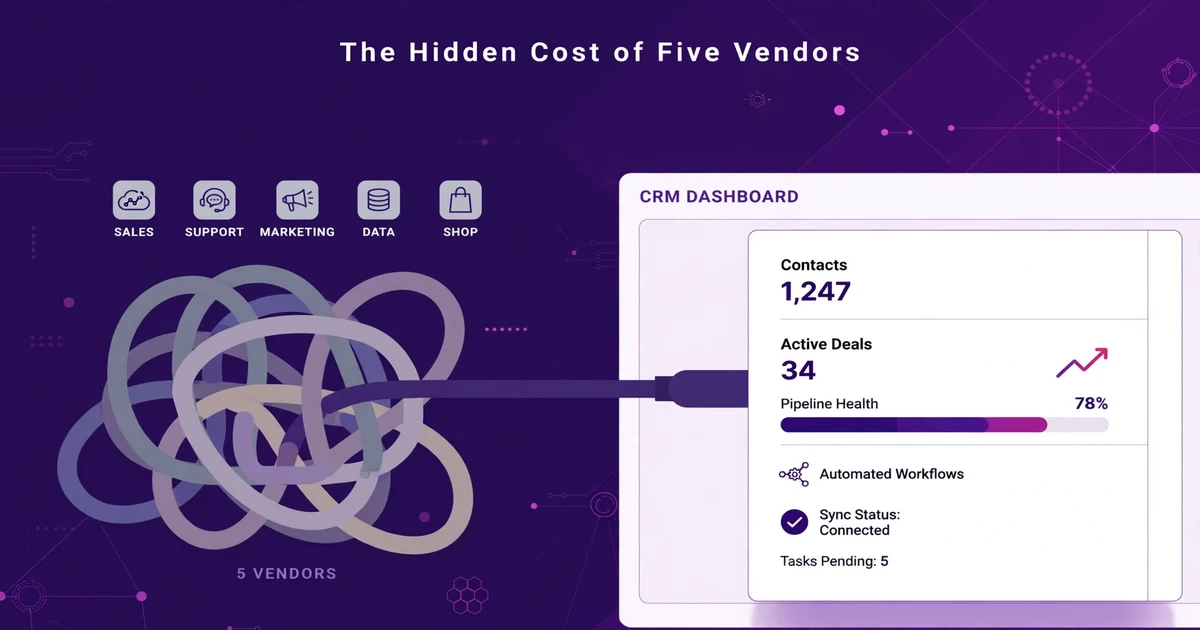
Running five marketing vendors means five separate contracts, five points of contact, five reporting formats and five tools that do not talk to each other, all of which the business owner has to hold together. Vendor fragmentation is the name for that state: marketing bought channel by channel, from different suppliers, with no single owner of the whole system.
A common version looks like this. An SEO freelancer on a monthly retainer. A paid ads agency taking a percentage of spend. A social media contractor posting three times a week. An email specialist who only touches the newsletter. A web developer on call for landing pages. None of them is expensive on their own. None of them sees the whole picture. And when a lead goes cold, each one can honestly say their part worked.
That last point is the heart of the problem. Fragmented vendors are accountable for their channel, not for revenue. The SEO freelancer reports rankings. The ads agency reports clicks. The social contractor reports engagement. All three reports can look good in the same month the pipeline gets worse, because nobody owns the handover between channels.
How much do five vendors really cost?
Five vendors at modest retainers cost roughly $6,000 a month in fees alone, before coordination time, tools and overlap are counted. The retainer figures below come from published industry surveys, and the worked example uses the low end of each range.
Industry benchmarks put the scale in context. SparkToro's State of Digital Agencies 2025 survey found that 49% of agencies report an average monthly retainer of $1,000 to $5,000, and a further 31% report $5,000 to $10,000. AgencyAnalytics' 2025 benchmarks report found the average client pays $4,800 a month for a single-channel engagement and $9,200 a month for multi-channel work. A single vendor is rarely cheap. Five of them are rarely a bargain.
Here is a realistic five-vendor setup, using the low end of typical ranges:
| Vendor | Channel | Typical monthly fee |
|---|---|---|
| SEO freelancer | Search rankings and content | $1,500 |
| Paid ads agency | Google and Meta campaigns | $1,500 |
| Social media contractor | Posting and community | $1,200 |
| Email and CRM specialist | Newsletters and follow-up | $1,000 |
| Web developer (on call) | Landing pages and fixes | $800 |
| Total | $6,000 a month |
That is $72,000 a year in fees. It is also the number most owners quote when they say marketing costs them $6,000 a month. The true number is higher, because the fees are only the visible part.
What are the five hidden costs?
The five hidden costs of vendor fragmentation are coordination time, duplicated tools, conflicting reporting, accountability gaps, and constant re-onboarding. Each one is small on its own. Together they are often larger than a retainer.
1. Coordination time is a salary you pay yourself
Coordination time is the hours the owner or marketing manager spends briefing, chasing, checking and reconciling five vendors, and it is the largest hidden cost. Five vendors means five kick-off calls, five monthly reviews, five sets of questions, and five people who need context before they can do anything useful.
A conservative estimate is five hours a week: one hour per vendor, every week, for briefings, reviews and follow-ups. The US Bureau of Labor Statistics puts the median pay for a marketing manager at $166,790 a year (May 2025), which works out to roughly $80 an hour. Five hours a week at that rate is about $400 a week, or roughly $1,700 a month and $20,800 a year, of management time spent coordinating vendors instead of growing the business. If the owner does the coordinating, the hourly value of their time is usually higher, not lower.
2. Duplicated tools are paid for twice
Duplicated tools are the subscriptions each vendor brings with them, and most of them overlap. The SEO freelancer has a rank tracker. The ads agency has a reporting dashboard. The social contractor has a scheduler. The email specialist has an automation tool. The developer has a form builder. Several of them do the same job, and the business pays for all of them, directly or inside the retainer.
Gartner's Marketing Technology Survey found that enterprise marketing teams now average 91 tools and use only 33% of their martech stack's capabilities, down from 58% in 2020. Smaller businesses run fewer tools, but the pattern is the same: each new vendor adds a tool, nobody removes one, and a third of what is paid for is never used. One team on one platform, by contrast, shares a single CRM, a single automation system and a single reporting view.
3. Conflicting reports hide what is actually happening
Conflicting reports are the different numbers each vendor produces for the same business, and they make decisions slower and worse. The ads agency counts a lead when someone clicks. The CRM counts a lead when someone books. The email specialist counts a lead when someone opens. Three definitions, three dashboards, three monthly reports, and no single answer to the question "did marketing work this month?"
The cost here is not a subscription. It is bad decisions made slowly: budget kept in a channel that looks good on its own report while the pipeline stalls, or a working channel cut because its numbers were measured differently. One team with one reporting view removes the argument about whose numbers are right, because there is only one set of numbers.
4. Accountability gaps are where leads go missing
An accountability gap is the space between two vendors where a task belongs to neither of them, and it is where leads go missing. The ads agency drives traffic to a landing page. The developer owns the page. The email specialist owns the follow-up. When the form breaks, the ads agency says the page is not theirs, the developer says nobody reported it, and the email specialist never sees the leads that never arrived.
This is the cost that never shows up in a spreadsheet. A broken form, a missed follow-up, a campaign pointing at an old offer: each one is a few days of lost leads, and each one is invisible until someone notices the pipeline has gone quiet. With one team and one project manager, the gap closes, because the same team owns the ad, the page and the follow-up.
5. Re-onboarding never stops
Re-onboarding is the cost of teaching each new vendor how the business works, and with five vendors it happens constantly. Freelancers leave, agencies reassign account managers, contractors go quiet. Every change means a new person learning the brand, the offer, the audience and the systems from scratch.
The 2026-11-06 comparison of in-house hiring versus a dedicated team put the average cost of one hire at $5,475 (SHRM 2025 benchmarking) and the median time to fill a role at 39 days (SHRM 2026 benchmarking). Vendor churn is cheaper than employee churn, but the pattern is the same: every replacement costs weeks of ramp-up during which output drops and the owner is briefing someone new. Five vendors multiply the chances of a change in any given quarter.
Five vendors vs one managed team: the comparison
One managed team covering the same work costs $1,250 a month, against about $7,700 a month for five vendors once coordination time is counted. The table below uses the worked example above, with coordination time valued at the BLS marketing-manager median, and CRM Automates' published shared-team price.
| Five separate vendors | One managed team (CRM Automates) | |
|---|---|---|
| Monthly fees | $6,000 | $1,250 |
| Coordination time | ~$1,700 a month (5 hrs/wk at ~$80/hr) | Included (project manager in the team) |
| Tools and reporting | Several overlapping subscriptions, several dashboards | One CRM, one automation system, one report |
| Accountability | Per channel; gaps between vendors | One team owns ad, page and follow-up |
| Roles covered | 5 channels, 5 people | 8 roles: CRM expert, media buyer, graphic designer, social media manager, video editor, SEO/AEO expert, growth maker, project manager |
| Contract | Five contracts, five notice periods | Month-to-month, cancel anytime |
| Monthly total | ~$7,700 | $1,250 |
| Annual total | ~$92,400 | $15,000 |
| Verdict | Best only if each vendor is genuinely best-in-class in a channel that matters most. | Best for businesses that want the same eight skill sets without the hiring, tools and management overhead. |
Two honest notes. First, the $1,250 team is a shared team: it works a 4-hour daily schedule and its capacity is shared, so it is not five full-time vendors working only for you. The like-for-like comparison for full-time coverage is CRM Automates' full-time team at $7,000 a month, still below the five-vendor total. Second, the vendor figures are an illustrative example built from published survey ranges, not a quote: your own five vendors may cost more or less, but the structure of the bill is the same.
Our dedicated team vs in-house comparison runs the same maths against hiring employees instead of vendors, and reaches the same conclusion: the fee is the smallest part of the bill.
When do multiple vendors still make sense?
Multiple vendors still make sense when one channel is so important to the business that it deserves a genuine specialist, and when the business has someone whose job is to manage vendors. A law firm whose entire pipeline comes from Google Ads may be right to pay a top ads specialist separately. A brand whose social presence is its main asset may be right to keep a dedicated social team.
The test is simple. If you can name the person who owns the whole system, and that person has the time and authority to hold five vendors to one plan, fragmentation can work. If the owner is that person, and the owner is also running the business, it usually does not. The vendors are not the problem. The missing owner is.
A second case is a short, defined project: a website rebuild, a one-off campaign, a specialist audit. Project work has a finish line, so the coordination cost ends. Retainers do not have a finish line, which is why five of them compound.
How to consolidate without breaking what works
Consolidation works when it is done in stages, keeping the best vendor output and moving one channel at a time. A rushed switch breaks the channels that were working.
- Map what each vendor actually delivers. List the five vendors, their fees, their tools and their outputs. Most owners find at least one vendor whose work nobody can describe.
- Rank the channels by revenue, not by activity. The channel that brings in booked calls matters more than the channel that produces the most posts.
- Move the weakest channel first. Start with the vendor whose output is hardest to measure or easiest to replace, and give the consolidated team one channel to prove itself on.
- Keep the best vendor for the channel that matters most. If one vendor is genuinely excellent in your most important channel, keep them and consolidate the other four. Consolidation is not all or nothing.
- Put one platform underneath everything. A single CRM with shared pipelines, calendars and reporting is what makes consolidation stick. Without it, one team just becomes a sixth vendor.
- Set one reporting standard before the move. Agree on what counts as a lead, a booked call and a closed deal, and make every report use the same definitions.
How CRM Automates replaces five vendors with one team
CRM Automates replaces five vendors with one managed marketing team of eight specialists, including a project manager, for $1,250 a month on a month-to-month basis. The team covers CRM, media buying, graphic design, social media management, video editing, SEO and AEO, growth and project management, so the ad, the landing page and the follow-up sit with the same people.
The difference is not just price. It is that the team works inside one system: GoHighLevel for the CRM, pipelines, calendars, email and SMS, with one reporting view and one project manager holding the plan together. That is what closes the accountability gaps and ends the five-report problem. The company is a GoHighLevel certified company, trusted by 300+ businesses, with a 150+ member team and a 94% client retention rate, and support runs 24/7 across US and UK timezones.
If the real question is not which vendor to keep but who will own the whole system, that is what the team is for. See the marketing team and what it covers. To talk through your current vendor setup and what consolidation would look like, book a free call.
Frequently asked questions
How many marketing vendors is too many?
Five vendors is too many when no single person owns the whole system and the owner is spending hours a week coordinating them. The number itself is less important than the coordination load: two vendors with one clear owner can work well, while three vendors with no owner can already waste money. If you cannot name who is accountable for revenue, rather than for a channel, you have too many vendors.
What is marketing vendor consolidation?
Marketing vendor consolidation is replacing several separate marketing suppliers with one team or platform that covers the same channels under a single contract, a single reporting view and a single point of accountability. The goal is not fewer suppliers for its own sake, but one owner for the whole marketing system, so the handover between channels stops being a gap where leads go missing.
How much does the average marketing agency retainer cost?
Most small and mid-sized agency retainers sit between $1,000 and $10,000 a month. SparkToro's 2025 survey found 49% of agencies report an average monthly retainer of $1,000 to $5,000, and 31% report $5,000 to $10,000. AgencyAnalytics' 2025 benchmarks put the average single-channel engagement at $4,800 a month and multi-channel work at $9,200 a month. Five vendors at the low end of those ranges still add up to roughly $6,000 a month in fees.
What is the hidden cost of multiple marketing vendors?
The hidden costs are coordination time, duplicated tools, conflicting reports, accountability gaps and constant re-onboarding. Coordination alone is worth about $1,700 a month if it takes five hours a week of a marketing manager's time, using the BLS median salary of $166,790 a year. Gartner found marketers use only 33% of their martech stack's capabilities, so duplicated tools are a real and measurable waste.
Is one marketing team better than several specialist vendors?
One team is better when the business needs the channels to work together and has nobody to manage five vendors. Several specialists are better when one channel dominates revenue and deserves a genuine expert, or when the business has a dedicated person managing vendors full-time. The honest test is whether anyone owns the whole system: if the answer is no, one team wins; if the answer is yes, specialists can work.
How do I consolidate marketing vendors without losing results?
Move one channel at a time, starting with the weakest or least measurable vendor, and keep the best vendor for your most important channel until the consolidated team has proved itself there. Put one CRM underneath everything, agree on one definition of a lead and a booked call, and give the new team a single reporting standard. A staged move protects the channels that work while the hidden costs come down.
The bottom line
Five vendors are rarely five good decisions. They are five small decisions that added up to a system nobody owns. The fees are visible and the hidden costs are not, which is why the setup survives: $6,000 a month looks reasonable until coordination time, duplicated tools, conflicting reports, accountability gaps and re-onboarding are added, and the total is closer to $7,700 a month.
One managed team does not win because it is cheaper, though at $1,250 a month it is. It wins because one team, one platform and one project manager close the gaps that five vendors leave open. If your marketing has five owners and no owner, consolidation is the fix.