GoHighLevel Lead Generation Automation: 2026 Guide
You bought GoHighLevel. You connected your ads. You built a funnel. Leads are coming in, but the response time is slow, follow-up is inconsistent, and half the pipeline goes cold before anyone on your team touches it.
This is the most common GoHighLevel lead generation automation failure in the USA and Canada right now. It's not a traffic problem. It's not even a GHL problem. It's a systems problem — specifically, the gap between what GoHighLevel is capable of and how it's actually set up.
The platform can capture a lead, qualify them, book a call, send the right follow-up at the right time, and re-engage dormant contacts without a human touching anything. But only if the automation logic is built correctly from the beginning. This guide shows you exactly how it works, where most setups break, and what separates a GoHighLevel installation that generates consistent revenue from one that collects leads and loses them.
What GoHighLevel Lead Generation Automation Actually Means
GoHighLevel lead generation automation is the practice of using GHL's workflow engine, pipeline management, and multi-channel communication tools to move contacts from initial inquiry through to booked appointment or closed sale — automatically, without manual intervention at each stage.
The platform was built specifically for this use case. According to GoHighLevel's own documentation, the workflow system supports conditional logic, time-based triggers, AI-driven responses, and integrations with SMS, email, voicemail drops, and Facebook Messenger — all within a single sub-account environment.
What makes GHL different from standard CRMs like HubSpot or Salesforce is that it combines the CRM, funnel builder, automation engine, and communication tools in one platform. You're not stitching Zapier between five separate tools. Everything is native.
That integration advantage is real. The execution risk is also real. Because everything is connected, a poorly built workflow doesn't just underperform — it actively damages your lead relationships by sending wrong messages at wrong times, triggering duplicate follow-ups, or dropping contacts out of the pipeline entirely.
The Lead Generation Automation Stack Inside GoHighLevel
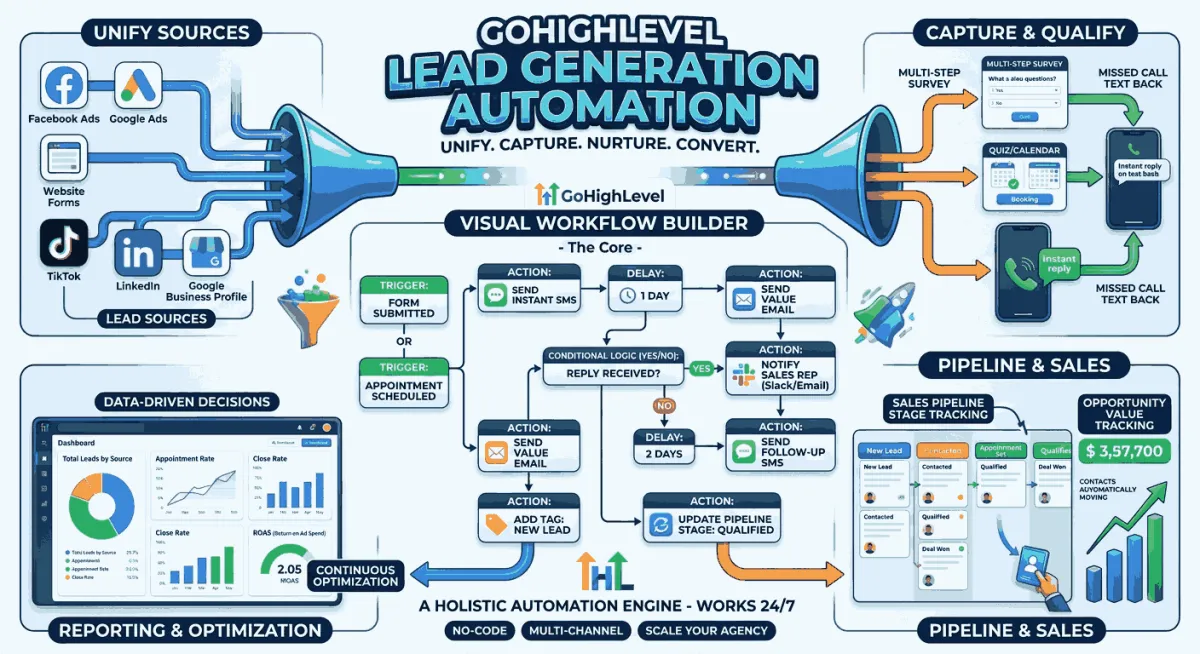
A properly built GHL lead generation system has six functional layers. Each one handles a specific job. Most businesses that struggle with GHL are missing at least two of them.
Layer 1: Lead Capture
Every lead generation automation starts with capture. In GHL, this can come from a native funnel page, an embedded form on your website, a Facebook Lead Ad integrated directly via GHL's native connector, an inbound call trigger, or a conversational AI chatbot deployed on your site.
The critical configuration detail most setups get wrong: the form or funnel must pass UTM parameters and source data into the contact record at the moment of capture. Without this, you can't segment your automations by source, can't measure which campaigns generate the highest-quality leads, and can't build conditional logic based on where the lead came from.
Layer 2: Instant Response
Speed-to-lead is not a theory. According to a 2024 study by Lead Connect, companies that respond within one minute see a 391% increase in conversion rates compared to those that wait five minutes or longer. In 2026, with AI-driven competitors responding in seconds, a two-hour manual callback window is effectively the same as no follow-up.
GHL handles this with a trigger-based workflow that fires the moment a form is submitted or a lead ad converts. The immediate response sequence typically includes an instant SMS with a personalized message, an email confirmation, and for qualified leads, an AI chatbot that opens a conversation thread and qualifies the lead before any human is involved.
This layer requires careful configuration of the initial trigger timing, the message content (which must not sound automated), and the conversation routing logic.
Layer 3: Qualification and Segmentation
Not all leads are equal. A home services company generating roofing leads in Texas needs different qualification logic than a marketing agency generating SaaS founder leads in Toronto. GHL's workflow system handles this through conditional branches — if/else logic that routes leads based on their answers to qualifier questions, their geographic location, the service they selected, or their source campaign.
For example, a roofing company using GHL might build a workflow that sends high-urgency repair leads directly to a phone call trigger within 90 seconds, while insurance claim leads get added to a longer nurture sequence that educates before selling. This kind of segmentation is not possible in a generic CRM without significant custom development.
Layer 4: Multi-Touch Nurture Sequences
This is where most GHL setups genuinely underperform. A lead who doesn't book on the first day isn't lost. They're in a decision process. A well-built GoHighLevel nurture sequence applies pressure in the right places over the right time horizon.
A practical multi-touch sequence for a high-ticket service business works like this: an immediate SMS with a calendar link fires the moment the lead submits, followed two hours later by an email introducing your value and a relevant case study. Day 1 brings a soft SMS check-in. Day 2 sends an email that handles the most common objections. Day 3 drops a voicemail that sounds personal, not robotic. Day 5 sends an SMS with a direct ask for a specific time slot. Day 7 delivers an email with social proof and a second calendar link. Day 14 re-engages with a fresh angle. Day 30 shifts to low-pressure long-term nurture.
The logic is not complicated. What is complicated is getting the message content right for each stage, setting the correct delay windows, and building the opt-out logic that removes contacts who have already booked from the nurture sequence automatically.
Layer 5: Pipeline Management and Deal Tracking
GoHighLevel's pipeline view gives you a visual representation of every active lead across every stage of your sales process. When automation is running correctly, contacts move through pipeline stages without manual dragging. A lead who books a call moves to "Appointment Scheduled" automatically. A lead who shows for the call moves to "Proposal Sent" based on a trigger tied to the outcome-tagging workflow.
In reviewing how agencies and home services businesses manage GHL pipelines in the US and Canada market, the most common structural error is building a single pipeline for everything. A business that has an inbound inquiry pipeline, a proposal pipeline, and a re-engagement pipeline running as one stage sequence creates data noise that makes it impossible to make meaningful decisions from pipeline reports.
Build separate pipelines for separate stages of the buyer journey. It seems like more complexity upfront but it produces far cleaner automation triggers and measurable conversion data.
Layer 6: Re-Engagement and Dormant Lead Recovery
This is the highest-ROI layer and the most consistently ignored one. Every GoHighLevel sub-account has contacts who expressed interest, entered the pipeline, and then went quiet. Most businesses treat these as dead. They're not.
A structured re-engagement campaign inside GHL can wake up dormant leads with a fresh angle, a seasonal trigger, or a changed offer. In practice, this means building a workflow that fires automatically when a contact has been sitting in a specific pipeline stage for more than 30 days without activity. The sequence reintroduces the business, acknowledges the time gap without apologizing, and presents a new reason to engage.
The dormant leads in your GHL right now represent the cheapest possible source of new revenue. They already know who you are. You spent money to acquire them. Re-engaging them costs nothing beyond the automation time to build the sequence correctly.
Where GoHighLevel Lead Generation Automation Breaks
Understanding the failure points is more useful than a checklist of things to do. These are the patterns that consistently appear in broken GHL setups across the USA and Canada.
Overlapping workflows that fire simultaneously. When a contact triggers multiple workflows at once — from a tag, a form submission, and a pipeline stage change — they can receive contradictory or duplicate messages within minutes. GHL's workflow execution order is not always intuitive, and building without a clear enrollment trigger strategy causes these collisions.
Missing stop-conditions. A nurture sequence that doesn't have a clear exit trigger will keep running after a lead books, shows for a call, or explicitly asks to stop receiving messages. This creates compliance risk under TCPA regulations in the United States and CASL in Canada, and it destroys the relationship with the lead.
A2P non-compliance killing SMS delivery. Since 2023, US carriers have required all business SMS to be sent through A2P 10DLC registered numbers. As of mid-2025, GoHighLevel introduced stricter enforcement of A2P compliance within sub-accounts, including automated account restrictions for unregistered senders. If your SMS automations are running on an unregistered number, your messages are being filtered or blocked. You won't get an obvious error — you'll just see zero response to your SMS sequences and assume the leads are bad.
No calendar friction reduction. A workflow that sends a Calendly link as the first action after lead capture is doing half the job. GHL's native calendar with embedded booking links, reminder automations, and reschedule workflows converts at a materially higher rate because the entire booking experience stays inside the GHL ecosystem and reminders are automated. Third-party calendar tools break the tracking chain and create gaps in your pipeline data.
Generic message content. A lead who submitted a form for HVAC services in Phoenix does not respond to the same message as a roofing contractor lead in Toronto. GHL supports dynamic merge fields, conditional content, and custom values that allow genuinely personalized messages at scale. Businesses that build their automations with static template copy leave significant conversion rate on the table.
GoHighLevel vs. Other CRM Automation Platforms: The Honest Comparison
For businesses in the USA and Canada evaluating their CRM and automation options, this comparison reflects real capability differences in 2026.
GoHighLevel includes a native funnel builder, native SMS automation with A2P compliance tools, native AI voice agents, white label capability, and sub-account management for agencies — none of which exist natively in HubSpot, ActiveCampaign, or Salesforce. HubSpot charges layered costs across its Marketing, Sales, and Service hubs, and SMS requires third-party integrations. ActiveCampaign is a capable email automation tool for SMBs but has no funnel builder or SMS stack. Salesforce with Pardot is built for enterprise sales teams with complex data structures, high implementation costs, and a learning curve that dwarfs GHL.
GoHighLevel's all-in-one plans run from $97 to $497 per month as of August 2026. Always verify current pricing at highlevel.com, hubspot.com, activecampaign.com, and salesforce.com before committing, as plans change.
One truth that most platform comparisons skip: GoHighLevel is not the easiest platform to use, but it is the most capable all-in-one option for businesses that need CRM, automation, funnel, and communication tools working together natively. The trade-off is setup complexity. You either invest the time to learn it deeply, or you hire experts who already have.
What an Expert-Built GoHighLevel Lead Generation System Looks Like
There's a meaningful difference between a GoHighLevel account that was set up by following YouTube tutorials and one built by someone who has architected hundreds of sub-accounts across different industries.
An expert-built system for a home services company in the US, for instance, would have distinct pipelines for inbound leads, quoted jobs, scheduled appointments, completed jobs, and review requests. Every pipeline stage transition would trigger a specific automation. Every SMS would be A2P registered and personalized with the contact's first name and service type. AI voice agents would handle initial qualification calls for leads that submit after business hours. Dormant leads from the past 90 days would be enrolled in a re-engagement sequence automatically. The calendar would have pre-appointment reminders at 24 hours and 2 hours before, plus a reschedule automation for no-shows.
All of this is possible in GHL. None of it is set up by default. Every workflow, trigger, and conditional branch has to be built intentionally.
If you want to audit your current GHL setup against this standard, CRM Automates offers a free sub-account audit that maps exactly what's working, what's broken, and what's costing you leads. The audit covers pipelines, automation logic, A2P compliance status, and conversion gaps — at no charge and no obligation.
Building vs. Hiring: The Real Cost Calculation for GoHighLevel Automation
For agencies and businesses in the USA and Canada weighing whether to build their GHL automation systems in-house or work with a specialist, the comparison is not just about price.
The honest time cost of building a properly architected GoHighLevel lead generation automation system from scratch — including research, workflow logic mapping, build time, testing, and iteration — is 80 to 120 hours for a competent non-specialist. At a founder's hourly opportunity cost of $150 to $300 per hour (a reasonable estimate for a scaling business operator), the DIY cost is $12,000 to $36,000 in time before a single lead is processed by the system.
A dedicated GHL specialist through CRM Automates runs $600 to $900 per month for 80 to 160 hours. The system goes live in 7 days. The expert manages ongoing optimization, A2P compliance, and workflow iteration as the business evolves.
The math is not subtle. For most businesses at the scaling stage, the decision to build in-house is not actually cheaper — it's just more familiar.
Who GoHighLevel Lead Generation Automation Works For (and Who It Doesn't)
GoHighLevel's automation capabilities are best matched to specific business types. Understanding the fit before investing saves significant time and money.
Strong fit:
Marketing agencies managing multiple client sub-accounts
Home services companies (HVAC, roofing, plumbing) with high inbound lead volume
Coaches and consultants running high-touch funnels with appointment booking
SaaS founders using GHL as their client-facing CRM and communication layer
Local service businesses with recurring customer relationships
Weaker fit:
E-commerce businesses that need deep Shopify or WooCommerce integration as the primary revenue driver
Enterprise businesses with complex Salesforce data structures that can't be migrated
Businesses with no current lead volume — GHL automation amplifies lead flow, it doesn't create it from nothing
Operators who are not willing to invest in either learning the platform deeply or hiring someone who has
GHL is a force multiplier. It makes good lead generation better and fast follow-up faster. It doesn't fix a broken offer or replace missing traffic.
Conclusion
GoHighLevel lead generation automation, built correctly, turns a fragmented manual sales process into a system that works around the clock — capturing, qualifying, nurturing, and booking leads without constant human intervention.
The gap between a GHL setup that generates consistent revenue and one that doesn't is almost never the platform itself. It's the architecture: the workflow logic, the pipeline structure, the A2P compliance, the nurture content, and the re-engagement triggers that most business owners never get to because they're too busy managing everything else.
If you're running GoHighLevel and not seeing the lead-to-appointment conversion you expected, the problem is almost certainly fixable — and it usually becomes clear within 30 minutes of looking at the right data. CRM Automates works with 300+ businesses across the USA and Canada to build and manage GHL systems that perform. Book a free strategy call and leave with a specific diagnosis of what's costing you leads right now.
The leads are there. The platform can close them. The system is what's missing.
FAQ SECTION
1. What is GoHighLevel lead generation automation? GoHighLevel lead generation automation uses GHL's native workflow engine to capture leads from funnels, forms, or ads and move them through qualification, follow-up, and booking automatically. It replaces manual outreach with conditional logic that sends the right message through the right channel at the right time — SMS, email, voicemail, or AI chatbot. The goal is to convert more leads without adding headcount or increasing response time.
2. How much does it cost to set up GoHighLevel lead generation automation? GoHighLevel itself starts at $97 per month for the Starter plan and $297 per month for the Pro/Agency plan as of 2026. Setup costs depend on who builds it. DIY requires 80 to 120 hours of build time. A certified GHL specialist typically costs $600 to $900 per month for ongoing management, with systems going live within 7 days. Always verify current GHL pricing at highlevel.com before committing, as plans change.
3. How long does it take to see results from GoHighLevel automation? A properly built lead generation automation system in GHL typically shows measurable impact within the first 30 days. The most immediate gains come from speed-to-lead improvements — responding to leads within 60 seconds instead of hours — and from automated re-engagement of dormant leads already sitting in the CRM. Longer-term nurture sequences compound over 60 to 90 days as the contact list grows.
4. What is the difference between GoHighLevel and HubSpot for lead automation? GoHighLevel combines CRM, funnel builder, SMS automation, AI voice agents, and white label capability in one platform at a lower price point than HubSpot's Marketing Hub. HubSpot is better suited to enterprise marketing teams that need deep reporting and Salesforce-adjacent data management. For agencies, home services, coaches, and SaaS founders in the USA and Canada, GoHighLevel delivers more relevant automation features at a fraction of the all-in cost.
5. What is A2P compliance and why does it matter for GoHighLevel SMS? A2P stands for Application-to-Person messaging. US carriers require businesses sending automated SMS through platforms like GoHighLevel to register their number and use case through the A2P 10DLC system. Since 2023, non-compliant SMS is filtered or blocked by carriers. As of mid-2025, GHL enforces stricter compliance checks at the sub-account level. If your GHL SMS sequences are seeing low response rates, unregistered A2P status is the first thing to check.