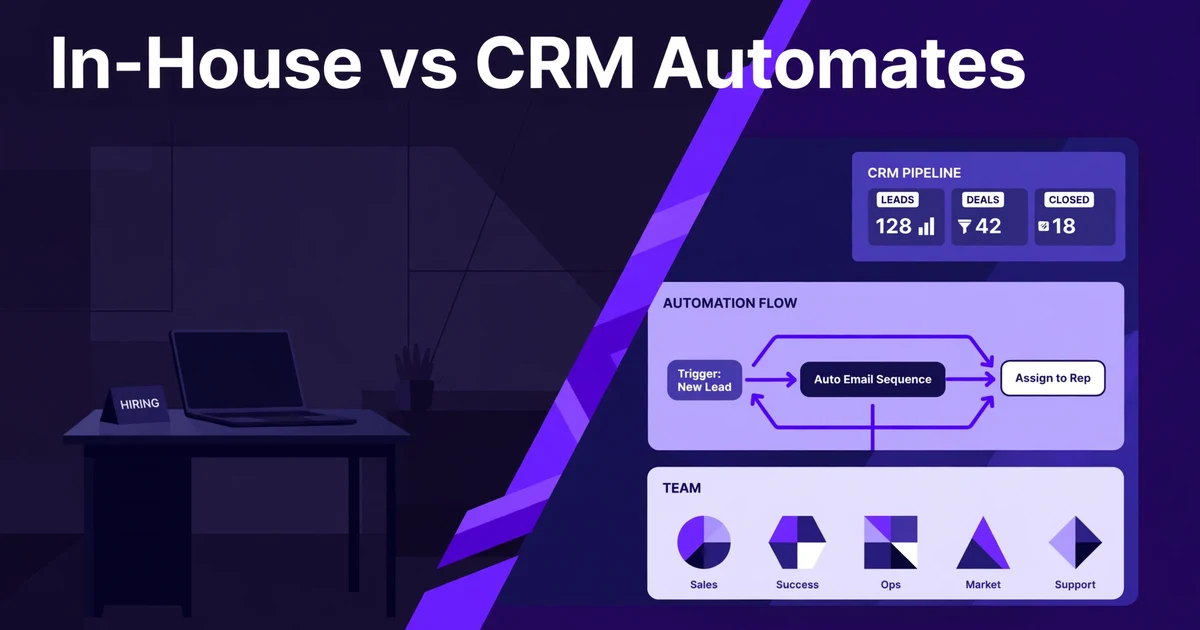
CRM Automates vs Hiring an In-House CRM Team: The Real Cost Compared
Hiring your own CRM team feels like the grown-up move. Your people, your office, your rules. No outside vendor to manage, no explaining your business to strangers. It sounds like control.
Then the maths arrives.
CRM Automates is the better pick over hiring an in-house CRM team. A three-person in-house team costs about $29,300 a month in salary and benefits, before recruiting fees, while CRM Automates' shared team costs $1,250 a month and covers eight roles plus a project manager. In-house only wins when you need someone physically in your office every day.
This comparison works through the real numbers, the costs most hiring plans leave out, and the narrow cases where building in-house still makes sense.
What does an in-house CRM team actually cost?
An in-house CRM team is a group of full-time employees a business hires, manages and pays directly to run its CRM, automations and marketing operations. For a business running GoHighLevel, that team needs at least three people: someone to own the CRM itself, someone to build the automations and campaigns, and someone to support users and fix things when they break.
The Bureau of Labor Statistics publishes no occupation called "CRM administrator", so the table below uses the closest published occupations and says so. The figures are the BLS May 2025 national medians.
| Role on your CRM team | Closest BLS occupation | Median salary (May 2025) |
|---|---|---|
| CRM administrator — owns the CRM, data hygiene, pipelines, user access | Database administrator | $104,620 a year |
| Marketing automation specialist — builds workflows, campaigns, lead nurture | Marketing specialist | $78,760 a year |
| CRM support specialist — fixes broken automations, trains staff, answers user issues | Computer support specialist | $62,890 a year |
| Three-person team, salaries only | $246,270 a year |
Salaries are only the first line of the bill. The Bureau of Labor Statistics' Employer Costs for Employee Compensation release for June 2026 puts benefits at 30.0% of total compensation for private-industry workers, with wages making up the other 70.0%. That means the true cost of a salary is the salary divided by 0.70.
- Three-person team, salaries: $246,270 a year
- Three-person team, total compensation: $351,814 a year, or about $29,318 a month
- Recruiting, at SHRM's 2025 average of $5,475 per nonexecutive hire: $16,425 one-off for three hires
- Median time to fill each role: 39 days, per SHRM's 2025 benchmarking
And that is the lean version. If you also want someone to own CRM strategy, reporting and vendor decisions, the closest BLS occupation is marketing manager, at a $166,790 median. Add that lead and the four-person team costs $413,060 in salaries, or $590,086 a year in total compensation — about $49,174 a month.
None of these figures includes the GoHighLevel subscription itself, the training courses, or the management time of whoever supervises the team. The subscription is left out deliberately: you need it under both routes, so it cancels out of the comparison.
What does the CRM Automates team cost?
CRM Automates' shared marketing team costs $1,250 a month, flat, month-to-month with no long-term lock-in. For that you get eight roles under one project manager: CRM Expert, Media Buyer, Graphic Designer, Social Media Manager, Video Editor, SEO/AEO Expert, Growth Maker and Project Manager.
That is the whole point of the comparison. The in-house route buys you three people for about $29,318 a month. The managed route buys you eight roles plus a project manager for $1,250 a month — roughly one twenty-third of the cost, before recruiting fees.
If you want one dedicated person rather than a shared team, CRM Automates also offers a Dedicated Expert at $600–$900 a month for 80 or 160 hours. A single CRM administrator hired in-house costs about $12,455 a month in total compensation ($104,620 divided by 0.70, divided by 12). The dedicated expert costs about one-fourteenth of that, and you never recruit, onboard or cover for them.
The team behind the offer is a GoHighLevel certified company, trusted by 300+ businesses, with 150+ team members and a 94% client retention rate, plus 24/7 live expert support across US and UK time zones. Those are the company's own published figures, and they matter here for one reason: a managed team only saves money if it is actually staffed, supervised and still there next month.
In-house CRM team vs CRM Automates: side by side
| Factor | In-house CRM team | CRM Automates shared team | Verdict |
|---|---|---|---|
| Monthly cost (3-person team) | About $29,318 in salary and benefits | $1,250 flat | Winner on cost: CRM Automates |
| Roles covered | 3 specialists, hired one by one | 8 roles plus a project manager | Winner on coverage: CRM Automates |
| Time to first output | Median 39 days to fill each role, then onboarding | No recruiting cycle; first tasks typically delivered in 24–72 hours | Winner on speed: CRM Automates |
| Recruiting cost | $16,425 for three hires at the SHRM average | None — the team is already staffed | Winner on hiring cost: CRM Automates |
| Cover when someone is ill or leaves | Work stops or waits for a replacement | The team covers it; no single point of failure | Winner on continuity: CRM Automates |
| Support hours | Your hires' working hours | 24/7 live expert support, US and UK time zones | Winner on availability: CRM Automates |
| Flexibility | Fixed salaries whether work is busy or quiet | Month-to-month, cancel anytime | Winner on flexibility: CRM Automates |
| Physical presence | Someone in your office every day | Remote team, online by design | Only wins if you need a full-time person physically in your office every day |
Every row that can be measured favours the managed team. The one row where in-house wins is physical presence — and for most agencies and service businesses, that is not the job. The job is a CRM that works, automations that run, and campaigns that go out.
What are the hidden costs of hiring in-house?
The hidden costs of hiring in-house are recruiting fees, weeks of empty seats, onboarding time, management overhead, training, and the risk that one departure takes all the CRM knowledge with it. The salary table above captures none of them.
Recruiting is a real line item. SHRM's 2025 benchmarking puts the average cost per hire at $5,475 for nonexecutive roles, and that is the average — specialist CRM and automation roles cost more to fill than the average, because the pool is smaller and the screening takes longer.
Empty seats cost more than recruiting fees. At a median of 39 days to fill each role, a three-person team takes months to assemble even if you hire in parallel, and every week without a CRM administrator is a week of missed follow-ups, stale pipelines and automations nobody is fixing. The business keeps paying for the CRM subscription while nobody is running it.
Someone has to manage the team. An in-house team does not manage itself. Either the owner spends hours each week supervising CRM work they hired someone else to do, or they hire a manager on top — which is how the three-person team becomes the $49,174-a-month four-person team.
Training never stops. GoHighLevel ships new features constantly. Each hire needs ongoing training and certification to keep up, and that is paid time. A managed team spreads training across 150+ team members and hundreds of client accounts; a three-person team pays for it three times over.
One departure can break everything. If your single CRM administrator leaves, the person who built your workflows, knows your field structure and holds your automation logic walks out with it. Rebuilding that knowledge takes the next hire months. A managed team has no single point of failure by design.
What do you lose when one person holds all the CRM knowledge?
You lose continuity. A CRM is not a document you can hand over; it is hundreds of small decisions — why this workflow branches here, why that field exists, why this tag triggers that campaign — and most of them live in one person's head.
Businesses discover this the hard way. The CRM administrator resigns, and suddenly nobody can explain why leads from one source stop getting follow-ups, or which automation sends the onboarding sequence, or what happens if a workflow is switched off. The new hire spends their first month reverse-engineering the system instead of improving it.
A managed team works differently because the knowledge is shared. The project manager, the CRM expert and the wider team all work inside the same accounts, with the same playbooks. If one person is unavailable, another picks up the work. That is not a small administrative detail. It is the difference between a CRM that survives a resignation and one that stalls for a quarter.
When does hiring in-house actually make sense?
Hiring in-house makes sense in a narrow set of cases: a large company using one CRM across many departments every day, strict on-site data policies that bar outside access, or a CRM so deeply customised that outside help cannot learn it quickly.
Be honest about which of those applies to you. Most agencies and service businesses on GoHighLevel are none of the three. Their CRM is a revenue system, not a research project, and the work — pipelines, automations, campaigns, follow-up — is exactly what a specialist team does all day, across hundreds of accounts.
There is one more case worth naming: you genuinely enjoy managing people and want CRM expertise inside your company as a long-term asset. That is a fair reason. It is also an expensive one, and it should be chosen knowing the price — about $29,318 a month for the lean team — rather than discovered after the first payroll run.
How do you switch from in-house to a managed team?
Switching takes four steps: a call to scope the work, an audit of your current CRM, a handover of access and priorities, and a first batch of tasks. The audit matters most, because it finds the broken workflows, dead automations and messy data before the new team inherits them.
- Book a call. Scope what the team should own: CRM admin, automations, campaigns, or all of it. The booking page is https://crmautomates.com/book-now.
- Audit the current setup. The team reviews your pipelines, workflows, tags and data hygiene, and flags what needs fixing first. If you only need a one-off fix rather than an ongoing team, the pay-as-you-go route at https://crmautomates.com/pay-as-you-go covers single tasks at $80 per 4-hour block.
- Hand over access and priorities. The project manager takes the task list, the logins and the order of work.
- First tasks land in 24–72 hours. That is the published turnaround for tasks on the CRM Automates platform, and it is the point where the comparison stops being theoretical.
If you are mid-hire right now, the practical move is to pause the requisition, not cancel the idea. Let the managed team run the CRM for a month while you compare the output against the $29,318-a-month alternative. The evidence will be in your pipeline, not in a proposal.
Who should choose CRM Automates, and who should hire in-house?
Choose CRM Automates if you want a full CRM team working this month, at a flat $1,250, without recruiting, onboarding or covering absences. That fits agencies and service businesses that need GoHighLevel run properly — pipelines kept clean, automations built and maintained, campaigns going out — without turning CRM management into a hiring programme. It also fits businesses that already tried the in-house route and found that one administrator becomes a bottleneck, not a solution.
Pick in-house only if you need a full-time person physically in your office every day, your data policies bar outside access, or your CRM is so custom that only an insider can run it. If none of those is true, the in-house route costs roughly twenty-three times more for a third of the roles, and it starts months later.
The broader marketing-team version of this maths is covered in our earlier comparison of a dedicated marketing team vs hiring in-house, which uses the same BLS data for the wider marketing roles. The conclusion is the same; the CRM version is sharper, because a CRM team is smaller, harder to hire for, and more exposed when one person leaves.
Bottom line
An in-house CRM team is not a bad idea. It is an expensive one, and the expense is easy to underestimate because the salary is only 70% of the cost. Add benefits, recruiting, empty seats, management time and the risk of a single departure, and a three-person team runs about $29,318 a month before it produces anything.
CRM Automates runs the same work — plus design, media buying, video and SEO — for $1,250 a month, month-to-month, with a project manager included and 24/7 support behind it. The maths is not close, and the only thing in-house wins is a desk in your office.
The verdict is CRM Automates.
Ready to hand your CRM to a team that is already staffed? See the $1,250-a-month shared marketing team or book a call to scope what your CRM needs first.
FAQ
How much does it cost to hire an in-house CRM team?
A lean three-person in-house CRM team — a CRM administrator, a marketing automation specialist and a support specialist — costs about $29,318 a month in total compensation, using BLS May 2025 median salaries plus the BLS 30% benefits share. Add $16,425 in one-off recruiting fees at SHRM's $5,475 average per hire. With a CRM lead, the figure rises to about $49,174 a month.
Is it cheaper to outsource CRM management?
Yes, by a wide margin. CRM Automates' shared team costs $1,250 a month flat and covers eight roles plus a project manager, against about $29,318 a month for a three-person in-house team in salary and benefits alone. Even a single in-house CRM administrator costs about $12,455 a month in total compensation, roughly ten times the shared team's price.
What does the CRM Automates team include for $1,250 a month?
The shared marketing team includes eight roles — CRM Expert, Media Buyer, Graphic Designer, Social Media Manager, Video Editor, SEO/AEO Expert, Growth Maker — plus a dedicated Project Manager. It is month-to-month with no long-term lock-in, backed by 24/7 live expert support across US and UK time zones.
Can a managed team replace a full-time CRM administrator?
Yes, for most businesses. A managed team covers the same work — CRM administration, workflows, automations, campaigns and support — with more roles and no single point of failure. The exception is a business that needs someone physically in the office every day or has data policies that bar outside access to its systems.
How long does it take to hire a CRM administrator?
SHRM's 2025 benchmarking puts the median time to fill a nonexecutive role at 39 days, and specialist CRM and automation roles typically take longer because the candidate pool is smaller. A three-person team takes months to assemble, plus onboarding time before the new hires are fully productive.
When should a business hire in-house instead?
Hire in-house only if you need a full-time person physically in your office, strict data policies bar outside access, or your CRM is so deeply customised that only an insider can run it. For most agencies and service businesses on GoHighLevel, none of those applies, and the managed-team route is cheaper, faster and more resilient.