GoHighLevel White Label CRM Services: Why Most Setups Fail
You've seen the pitch. License GoHighLevel, slap your logo on it, sell it to local businesses at a markup, and collect recurring revenue while you sleep. The math is seductive. One $497-per-month GoHighLevel SaaS Pro plan supports unlimited sub-accounts. Charge each client $297 per month. Land ten clients. That's $2,970 in monthly recurring revenue against a $497 platform cost.
Then reality arrives.
Your branded login page still leaks GoHighLevel identifiers in the source code. A client notices and asks uncomfortable questions. Email deliverability collapses because nobody configured SPF, DKIM, and DMARC properly. SMS messages get blocked because A2P 10DLC registration wasn't completed. Automations misfire at scale, creating support tickets that eat your entire Friday.
This is the gap between the sales pitch and actual GoHighLevel white label CRM services. Understanding it before you invest determines whether you build a genuine SaaS revenue stream or abandon the project within six months.
What White Label GoHighLevel Actually Means
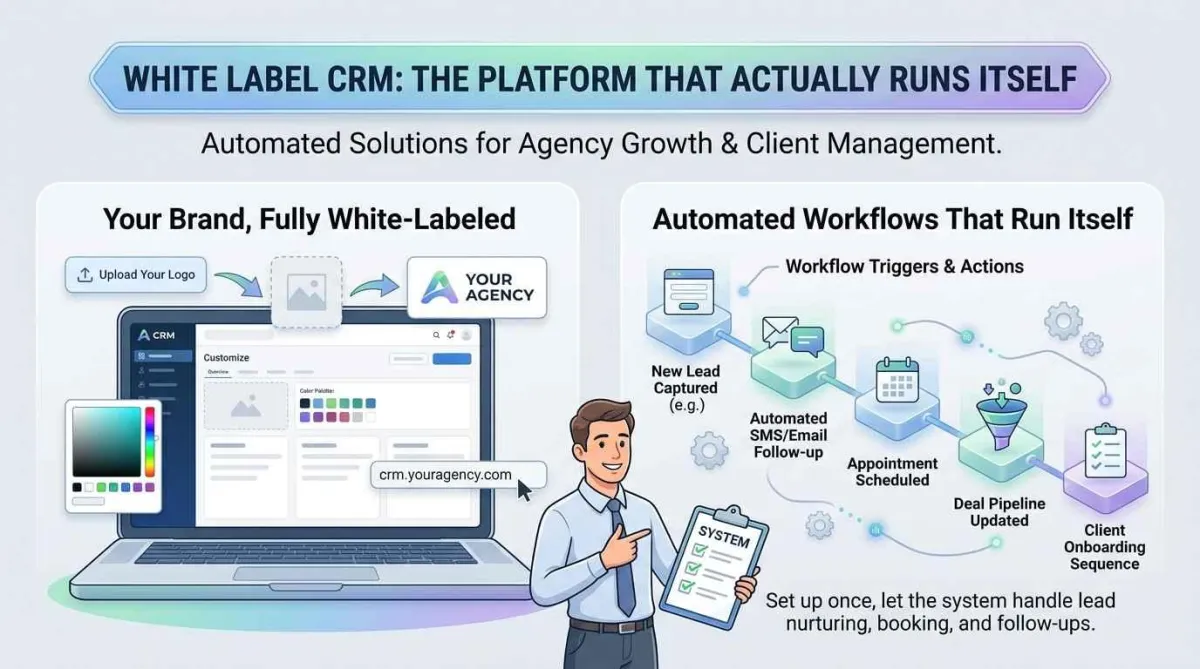
White labeling GoHighLevel means rebranding the entire platform—login portal, dashboard, mobile app, email domains, and client-facing interface—so your customers see your agency brand, not GoHighLevel. When a client logs into crm.youragency.com, they see your logo, your colors, and your platform name. GoHighLevel disappears from view.
The SaaS Pro plan at $497 per month activates this capability fully. It includes SaaS Mode with automated subscription billing through Stripe, tiered plan creation with feature gating, a branded mobile app for iOS and Android, and the administrative backend to manage unlimited client sub-accounts. A 2026 analysis found that agencies running white-label GHL SaaS report average monthly recurring revenue between $15,000 and $45,000, with profit margins exceeding 70% once the platform cost is covered. The best operators scale past 200 clients with a three-person team.
Those numbers are real. But they describe the destination, not the journey. The gap between buying the SaaS Pro plan and reaching those revenue figures is where most operators stall.
The Three Infrastructure Failures That Sink White Label Setups
In side-by-side evaluations of GoHighLevel instances built by different providers, the same structural weaknesses appear repeatedly. Most setups look functional on the surface but collapse under scale.
1. Incomplete Branding
True white labeling goes beyond uploading a logo and setting a custom domain. GoHighLevel's source code still contains references to "GHL," "Lead Connector," and "GoHighLevel" that are visible through browser inspection tools. Support documentation links can default back to GoHighLevel help pages, exposing the underlying platform. A proper white-label build requires DNS configuration with CNAME records, custom SMTP domains for email sending, and careful auditing of every client-facing touchpoint. Agencies that skip this step face client trust erosion when the platform's true origin becomes visible.
2. Email and SMS Infrastructure
White labeling means your clients send emails through your branded domain, not GoHighLevel's shared IPs. Without proper SPF, DKIM, and DMARC authentication records configured at the DNS level, deliverability plummets. A 2026 Centripe review documented open rates dropping from 35% to as low as 9% post-migration when email authentication wasn't properly set up. SMS adds another layer of complexity. A2P 10DLC registration is mandatory for any business texting U.S. phone numbers through GoHighLevel. Every sub-account must complete brand and campaign registration, or carriers block the messages. The GoHighLevel Trust Center introduced AI-powered compliance validation in early 2026 specifically because agencies were submitting incomplete registrations and getting rejected.
3. Sub-Account Architecture
Most DIY builds start with a single snapshot deployed to every new client. That works for five accounts. At twenty, the snapshot shows its age. At fifty, you're maintaining multiple conflicting versions with no version control. A scalable architecture requires master snapshots with documented update paths, clean permission structures, and automated deployment processes. Without this, onboarding each new client becomes a manual, error-prone project.
The Support Burden Nobody Mentions
A widely cited LinkedIn analysis from Extendly identified the single most common reason GoHighLevel SaaS agencies fail: they cannot keep up with customer support. Agencies lose clients not because the software is bad, but because questions go unanswered, workflows break, and nobody is available to fix them on a Tuesday afternoon.
When you sell a white-label CRM, you're not just selling software access. You're selling the expectation that someone will help when things go wrong. A solo operator charging clients $297 per month for platform access will quickly drown in support tickets at twenty accounts. Client onboarding alone—configuring pipelines, importing contacts, setting up automations—can consume ten to fifteen hours per new account.
The agencies that scale successfully either build internal support teams or partner with specialized white-label support providers. The 2026 landscape includes services like Extendly for flexible scaling, HL Pro Tools for coaching and systems alongside support, and Agency Owner Support for high-touch onboarding with Zoom and phone assistance. The alternative—and the path that consistently produces better long-term outcomes—is engaging a partner that provides fully managed execution, not just ticket-based support.
When DIY Setup Makes Sense—And When It Doesn't
A solo marketing consultant with three existing clients who wants to offer a branded CRM as an upsell can likely handle the setup independently. The GoHighLevel Unlimited plan at $297 per month provides white-label desktop capability without the full SaaS Mode complexity. Configure a clean sub-account template, set up DNS records, and start small. At this scale, the platform cost is modest and the support burden is manageable.
An agency with twenty-plus active clients, ambitions to scale past fifty, or plans to sell CRM access as a standalone SaaS product needs a different approach. At this level, sub-account architecture determines whether you grow or stall. Clean automation logic, documented pipeline stages, standardized snapshots with version control, and A2P-compliant SMS infrastructure become non-negotiable. The cost of fixing a poorly architected system at scale far exceeds the cost of building it correctly from the start.
The trade-off is straightforward. DIY setup saves upfront cash but costs time, generates errors, and typically needs a full rebuild within twelve to eighteen months when the sub-account count exposes structural weaknesses. Professional engineering costs more upfront but produces documented, repeatable infrastructure that scales without daily intervention.
CRM Automates: Engineered Infrastructure, Not Configuration
This is where the conversation shifts from software features to execution. Anyone can configure GoHighLevel settings. Very few can architect the infrastructure so it stays stable as sub-accounts multiply, team members change, and offers evolve.
CRM Automates operates on a different premise than most GoHighLevel service providers. They describe themselves not as a setup team but as a backend systems partner. Their approach starts with an audit of your existing setup, identifies structural bottlenecks in data models, tags, automations, handoffs, and reporting blind spots, then deploys a dedicated engineering team to build or rebuild the infrastructure aligned with your revenue model. The build is documented, structured to scale, and monitored continuously as your volume and offers change.
The difference is measurable. DIY or freelancer-built setups typically achieve functional but fragile outcomes. CRM Automates reports 99.3% execution uptime, over 160 hours per month of time unlocked for their clients, and a process that maps automation directly to revenue outcomes—lead conversion, client retention, and pipeline visibility. Their team manages sub-account architecture, white-label infrastructure, A2P approvals, brand registration, and SMS deliverability as an integrated layer, not a checklist of isolated tasks.
For agencies in Canada, the US, or UK markets scaling beyond the solo operator ceiling, the choice is not whether to invest in infrastructure. It's whether to build it through trial and error over eighteen months or deploy it in weeks with a team that has already solved the problems you haven't encountered yet.
Seven Questions That Reveal Whether Your White Label Setup Is Ready to Scale
Use these to audit your current build—or evaluate any provider before you commit.
1.Can I onboard a new client and deploy their fully configured sub-account in under two hours?
2.If a client inspects the browser source code on their login page, will they find any GoHighLevel branding?
3.Are SPF, DKIM, and DMARC records configured and verified for every sending domain?
4.Has A2P 10DLC brand and campaign registration been completed for every sub-account sending SMS to U.S. numbers?
5.Do my automation workflows include error handling and fallback paths, or do they silently fail?
6.If I step away for two weeks, does client onboarding and support continue without me?
7.Do I have documented snapshots with version control, or am I manually copying configurations between sub-accounts?
Selling GoHighLevel under your own brand is one of the most direct paths to recurring SaaS revenue available to agencies in 2026. The platform economics are sound. The market demand exists. But the execution gap between a login that works and infrastructure that scales is wide, and most operators discover this after their first support crisis or client churn event.
CRM Automates closes that gap. They don't just configure software. They engineer the backend that makes your revenue predictable, your team accountable, and your operations scalable without you. If your white-label CRM feels fragile, dependent on you personally, or stuck at a revenue ceiling, the problem isn't GoHighLevel. It's what's underneath. Fix that, and everything else compounds.
Frequently Asked Questions
What is GoHighLevel white label CRM?
A rebranded version of the GoHighLevel platform sold under your agency's own brand. Clients log into a dashboard with your logo, domain, and pricing, accessing CRM, funnel building, email and SMS automation, and pipeline management tools—without ever seeing the GoHighLevel name.
How much does GoHighLevel white label cost?
The SaaS Pro plan costs $497 per month and includes full white-label capability, SaaS Mode with automated billing, unlimited sub-accounts, and a branded mobile app. The Unlimited plan at $297 per month offers basic white-label desktop customization without full SaaS resale features.
How much can I charge clients for my white label CRM?
Most agencies charge between $297 and $997 per month per client depending on included features and support level. With the SaaS Pro plan at $497 per month, you cover costs after just two to three clients.
What are the most common white label setup mistakes?
Incomplete branding that leaves GoHighLevel identifiers visible in source code, missing email authentication records that destroy deliverability, skipped A2P 10DLC registration that blocks SMS messages, and poorly structured sub-account architecture that collapses under scale.
Do I need A2P 10DLC registration for my white label CRM?
Yes. Any business sending SMS to U.S. phone numbers through GoHighLevel must complete A2P 10DLC brand and campaign registration for each sub-account. Failure to register results in carrier-level message blocking. This is mandatory, not optional.
What email deliverability issues affect white label GoHighLevel?
Without proper SPF, DKIM, and DMARC records on custom sending domains, emails often land in spam or get blocked entirely. Open rates can drop from 35% to below 15% after migration if authentication isn't properly configured.
Can I white label the GoHighLevel mobile app?
Yes. The SaaS Pro plan includes a white-label mobile app that clients download from the Apple App Store and Google Play Store under your brand name and logo. This significantly increases perceived value and client retention.
Why do GoHighLevel SaaS agencies fail?
The most common reason is the inability to keep up with customer support. Agencies lose clients when technical questions go unanswered and workflows break with nobody available to fix them. Successful operators either build support teams or partner with managed service providers.
How is CRM Automates different from other GoHighLevel service providers?
CRM Automates engineers revenue infrastructure rather than simply configuring software. They audit existing setups, identify structural bottlenecks, deploy dedicated engineering teams, and provide ongoing monitoring and optimization—documented, scalable, and managed rather than a one-time freelancer handoff.
How long does a professional white label GoHighLevel build take?
Typically two to six weeks depending on complexity, sub-account count, and integration requirements. An initial audit and roadmap phase clarifies the exact timeline and priorities before any changes are made to the live environment.
What profit margins are possible with a GoHighLevel white label SaaS?
Agencies report average monthly recurring revenue between $15,000 and $45,000, with profit margins exceeding 70% after covering the platform subscription. The best operators scale past 200 clients with lean teams of three people.
Can CRM Automates fix an existing GoHighLevel setup that has problems?
Yes. Most clients come with partial setups or messy workflows. CRM Automates audits the existing configuration, cleans up the CRM and automations, and reconfigures the infrastructure to be stable at scale while preserving what already works.